Graphiti | Real-Time Temporal Knowledge Graph Engine for AI Agents
Graphiti
Introduction
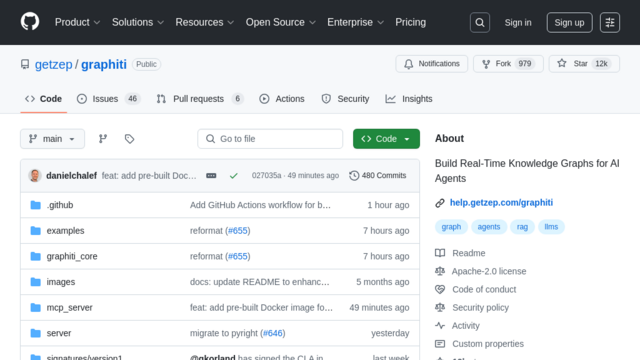
Graphiti is an open-source (Apache 2.0) Python framework developed by Zep for building dynamic, real-time temporal knowledge graphs (Context Graphs) for AI agents. Unlike traditional static RAG pipelines or basic vector databases, Graphiti continuously ingests episodic user interactions and structured/unstructured business data, maintaining an evolving timeline of facts and relationships. By preserving periods of validity for facts, it prevents memory context degradation and allows AI agents to query state changes and historical timelines accurately over time.
Use Cases
Long-Term Conversational Agent Memory
Track evolving user preferences, life changes, and ongoing conversations over long horizons without context fragmentation or overwrite errors.
Enterprise Entity & Relationship Tracking
Continuously index multi-source business data (e.g., support logs, client communications, project updates) into a connected, temporally aware entity graph.
State-Based Temporal Reasoning & Auditing
Query historical states of a knowledge base (e.g., ‘What was the customer’s subscription plan on June 15th?’) to perform precise logic checks and audits.
Dynamic Knowledge Graph Construction for GraphRAG
Replace manual graph generation pipelines with an incremental, non-lossy ingestion engine that dynamically updates graph nodes and edges without full graph re-indexing.
Features & Benefits
Temporal Fact Maintenance & Invalidations
Tracks periods of validity for node and edge relationships, automatically marking outdated facts as historical when new contradictory statements arrive.
Incremental Non-Lossy Graph Updates
Updates entity nodes and relationships dynamically upon receiving new stream events, eliminating the need to rebuild entire knowledge graphs from scratch.
Hybrid Context Retrieval Framework
Combines vector similarity search, BM25 keyword search, and graph traversal algorithms to surface relevant context and subgraphs for LLM prompts.
Neo4j & Native Graph Database Integration
Leverages property graph databases (such as Neo4j) under the hood for storing entities, relationships, and temporal metadata.
Model-Agnostic LLM & Embedder Drivers
Integrates with major AI model providers (OpenAI, Anthropic, Gemini, or local Ollama instances via generic client wrappers).
MCP Server & API Service Options
Provides Model Context Protocol (MCP) server support and FastAPI-based service wrappers for easy integration into agent frameworks like LangGraph, CrewAI, and AutoGen.
Solves Temporal Memory Decay
Prevents AI agents from acting on stale or contradictory context by maintaining precise time-anchored relationship histories.
Eliminates Graph Re-Indexing Costs
Supports real-time incremental updates, keeping operational latency and token expenditure low as memory scales.
Open-Source Core Under Apache 2.0
Provides complete architectural transparency and self-hosting freedom for developers building custom agent memory infrastructure.
Cons
Infrastructure Complexity
Requires running and maintaining a graph database instance (such as Neo4j) along with embedder/LLM connectivity, increasing operational overhead.
Higher Initial Ingestion Latency
Extracting entities, resolving node identities, and updating temporal edges asynchronously consumes more background compute than simple raw text embeddings.