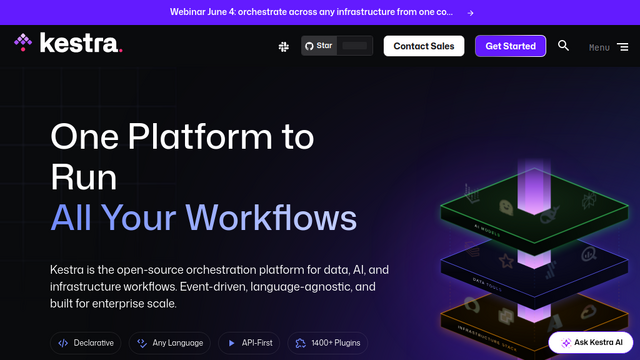
Kestra is an open-source (Apache 2.0), event-driven orchestration engine built to simplify complex data pipelines, infrastructure automation, and software workflows. By using declarative YAML definitions (‘everything as code’) alongside a real-time visual UI, Kestra enables developers, data engineers, and operations teams to build, schedule, execute, and monitor end-to-end tasks without being locked into custom Python SDKs or proprietary runtimes.
Use Cases
Data Pipeline & ETL/ELT Orchestration
Coordinate complex data transformations across modern stacks like Snowflake, BigQuery, dbt, Airbyte, and DuckDB with built-in retries and state tracking.
Event-Driven Infrastructure Automation
Trigger automated operational tasks, cloud deployments, and container runs immediately upon receiving webhooks, Kafka messages, or file system uploads.
Polyglot Code Execution
Run task logic written in Python, R, Node.js, Shell, or Go within isolated Docker containers without managing dedicated worker clusters.
Interactive Business & DevOps Workflows
Build human-in-the-loop workflows that pause for user approvals or manual inputs before executing critical downstream steps.
AI & Agentic Flow Coordination
Chain together LLM calls, vector database indexing steps, and custom AI agents using Kestra’s native AI copilot and agentic task plugins.
Features & Benefits
Declarative YAML & UI Synchronization
Define workflows completely in YAML or build them visually in the UI—changes sync bi-directionally in real time with Git version control compatibility.
Extensive Plugin Ecosystem (1,800+ Plugins)
Connects natively to major cloud platforms (AWS, GCP, Azure), data platforms, messaging queues, and enterprise APIs out of the box.
Language-Agnostic Task Runners
Execute scripts in any programming language inside Docker, Kubernetes, or local task runners without custom runtime wrappers.
Rich Visual Topology & Monitoring UI
Includes a full-featured web dashboard with interactive execution topology graphs, real-time log streaming, and Gantt performance views.
Enterprise Governance & Access Controls
Enterprise and Cloud tiers add granular Role-Based Access Control (RBAC), multi-tenancy, secrets management integration, and detailed audit logs.
Zero SDK Lock-In
Writing workflows in simple YAML means pipelines aren’t tightly coupled to specific code libraries or runtime versions.
Bridge Between Engineers and Non-Technical Stakeholders
Developers can commit YAML files via Git while product or ops managers inspect execution states and trigger runs through the web UI.
Highly Scalable Architecture
Designed for scale using a JDBC-backed or Kafka-backed state store, running smoothly from a single Docker container up to enterprise Kubernetes clusters.
Cons
YAML Expressiveness Curve
Complex conditional logic or heavy dynamic task generation requires mastering Kestra’s Pebble template expressions within YAML files.
Smaller Legacy Ecosystem Compared to Airflow
While growing fast, the third-party community library footprint is younger than older legacy orchestrators like Apache Airflow.