VeloDB | Unified Real-Time Analytics, Search & AI Database
VeloDB
Introduction
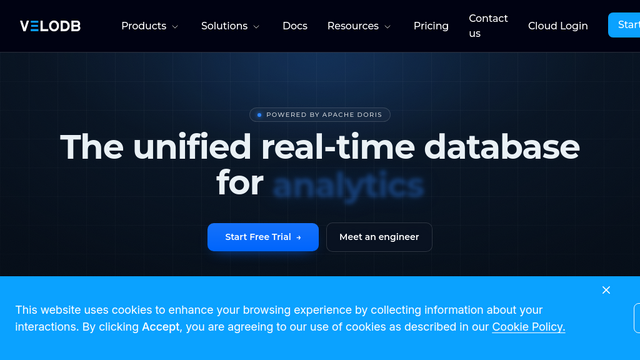
VeloDB is an enterprise-grade, cloud-native real-time analytical database and managed service built on top of Apache Doris—one of the fastest open-source Massively Parallel Processing (MPP) analytical engines. Designed to unify real-time business intelligence, log search, and AI retrieval within a single vectorized engine, VeloDB eliminates the complexity of stitching together separate OLAP data warehouses, search clusters, and vector databases. Offering sub-second query latencies over petabyte-scale datasets, 100% MySQL protocol compatibility, and zero-copy Lakehouse integration (Apache Iceberg, Delta Lake, LanceDB), VeloDB provides an all-in-one data layer for high-concurrency dashboards, streaming ingestion, and AI agent workloads.
Use Cases
Sub-Second Real-Time BI & Interactive Dashboards
Power user-facing reporting tools, financial telemetry, and high-concurrency executive dashboards with sub-second response times over billions of records.
Unified Full-Text & Log Search Analytics
Replace dedicated Elasticsearch/OpenSearch clusters by executing inverted-index full-text search, semi-structured JSON querying, and aggregate analytics directly in the same columnar engine.
AI Agent Retrieval & Hybrid Vector Search
Serve as a real-time retrieval layer for AI agents and RAG pipelines, combining dense vector embeddings, keyword search, and metadata filtering in single-stage SQL queries.
Open Data Lakehouse Acceleration
Query and accelerate data residing in external cloud storage and open table formats (Apache Iceberg, Delta Lake, Apache Hive) without duplicating or moving raw data assets.
High-Throughput Streaming Ingestion & A/B Metric Computation
Ingest millions of real-time events per second from Kafka, Flink, and Spark to calculate live experiment metrics and operational alerts with zero ingestion lag.
Features & Benefits
Vectorized MPP Execution Core
Leverages SIMD-vectorized execution, cost-based query optimization (CBO), and columnar storage to maximize CPU cache utilization and query throughput.
Hybrid Search (Vector + Full-Text + Relational OLAP)
Natively combines inverted index search, vector distance computation, and standard SQL relational operations within a unified query path.
100% MySQL Protocol & Ecosystem Compatibility
Integrates seamlessly with existing SQL clients, BI platforms (Tableau, PowerBI, Superset), and data tools (dbt, Flink, Spark) using standard MySQL connectors.
Multi-Cloud & Flexible Deployment Topologies
Deploys as a fully managed SaaS on AWS, GCP, and Azure, a Bring-Your-Own-Cloud (BYOC) VPC architecture, or self-managed Kubernetes/On-Premise clusters.
Python UDF Integration for Agent Workflows
Allows developers to define and run Python functions (Pandas, PyArrow) directly inside the SQL query lifecycle for advanced analytical and AI tasks.
Automated Tiered Storage & Cost Governance
Dynamically moves historical cold data to inexpensive object storage (S3/GCS) while keeping hot working datasets in NVMe/SSD local caches.
Massive Stack Simplification
Consolidates separate OLAP databases, full-text search engines, and vector stores into one single engine, eliminating brittle cross-database ETL syncs.
Zero Migration Friction
Native MySQL dialect and open Apache Doris foundation prevent vendor lock-in and enable instant drop-in replacement for existing reporting pipelines.
Extreme Performance at High Concurrency
Handles thousands of concurrent analytical queries per second over massive tabular datasets with consistently low latency.
Cons
Not Designed for Heavy OLTP / Point Mutations
Optimized specifically for analytical, append-heavy, and batch-updated workloads rather than high-frequency transactional row updates.
Cluster Sizing & Resource Tuning Curve
Self-managed enterprise deployments on Kubernetes require proper capacity planning across Frontend (FE) and Backend (BE) nodes to balance memory and compute.