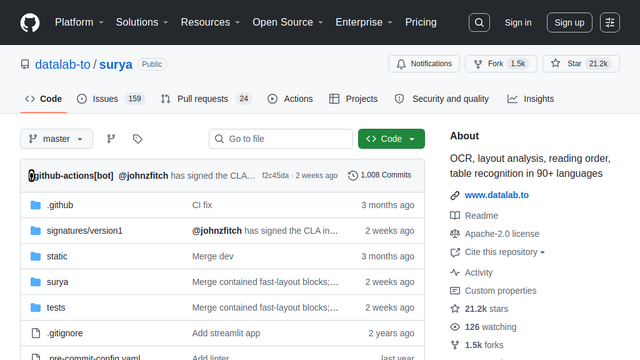
Surya is an open-source (Apache 2.0) multilingual document analysis toolkit developed by Datalab (the creators of Marker and Chandra). Designed to turn raw document images and multi-column PDFs into structured, machine-readable representations, Surya provides end-to-end processing across 90+ languages. Beyond raw text optical character recognition (OCR), Surya handles document layout detection (18+ block labels), reading order sorting, table structure recognition (HTML with spans), and line-level bounding box detection using compact, highly efficient vision-language architectures.
Use Cases
Multi-Column & Complex Layout Document Parsing
Extract text from academic papers, magazines, and dense corporate reports while accurately reconstructing natural reading order across multi-column flows.
High-Accuracy Multilingual OCR (90+ Languages)
Digitize printed documents, mixed-script texts, and non-Latin alphabets with specialized tokenizers and language-specific OCR checkpoints.
Table Detection & HTML Structure Extraction
Detect table boundaries in documents and extract row/column geometry, producing clean HTML representations with support for merged rows and column spans (colspan/rowspan).
Mathematical Equation & Code Recognition
Isolate formulas, equations, and code blocks from prose text, rendering mathematical notations directly into clean LaTeX or structured blocks.
Document Pre-Processing for Agent RAG Pipelines
Convert raw scanned PDFs into semantically chunked, layout-aware blocks to prevent context fragmentation in vector databases and RAG workflows.
Features & Benefits
Unified Multi-Task Architecture
Combines layout analysis, full-page OCR, reading order inference, and table extraction in a single compact model footprint (~650M parameters).
Precise Reading Order Detection
Calculates a 0-indexed reading order position for each recognized block to ensure extracted text preserves logical narrative flow.
Pluggable High-Throughput Inference Engines
Supports vLLM (with Multi-Token Prediction speculative decoding) for NVIDIA GPUs, alongside llama.cpp/GGUF quantization for Apple Silicon (MPS) and CPU execution.
Line-Level Bounding Box Geometry
Emits exact 4-corner polygon coordinates and axis-aligned bounding boxes (bbox) with per-token confidence scores.
Lightweight Footprint with Enterprise Precision
Delivers benchmark-leading accuracy under 3B parameters, running efficiently on consumer GPUs, Apple Silicon, and commodity CPUs.
Preserves Logical Reading Order
Eliminates the multi-column text mixing common in naive OCR tools, producing clean text streams for LLM consumption.
100% Permissive Open Source (Apache 2.0)
Free for commercial deployment and self-hosting, ensuring total data privacy and zero per-page third-party API costs.
Cons
Inference Compute Demands on Batch Processing
Running full-page VLM inference across massive multi-thousand-page document archives requires dedicated GPU acceleration (e.g., vLLM) to maintain low latency.
Heavily Degraded / Cursive Handwriting Limits
While excellent at printed documents and clean forms, heavily degraded historical manuscripts and unconstrained cursive script may experience lower accuracy.