Strix | Open-source AI hackers for your apps


Strix
Strix

Introduction

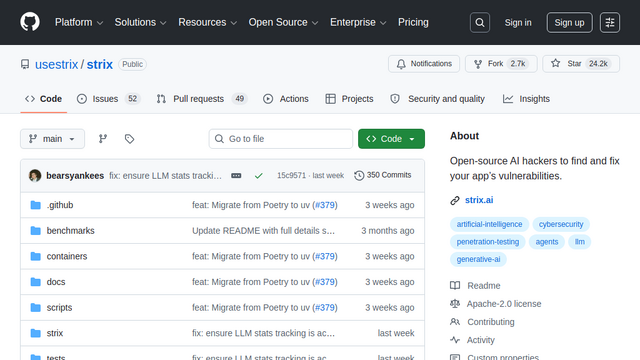
Strix is an autonomous, agentic security platform designed to function as a ‘team of AI hackers’ that find and fix vulnerabilities in modern applications. Unlike traditional scanners that rely on static signatures, Strix uses advanced LLM-based reasoning to plan, investigate, and validate security issues end-to-end. It mimics the workflow of a human penetration tester—discovering endpoints, crafting payloads, and generating verified Proof-of-Concepts (PoCs) to ensure zero false positives, all while integrating directly into developer workflows and CI/CD pipelines.

Use Cases

  • Automated Penetration Testing
    Run exhaustive security audits on web apps and APIs in hours instead of weeks, receiving a professional-grade report with actual exploit code.
  • CI/CD Security Guardrails
    Integrate Strix into GitHub Actions to scan every pull request for vulnerabilities like IDOR or SQLi, blocking insecure code before it reaches production.
  • Bug Bounty Automation
    Automate the tedious reconnaissance and initial exploitation phases of bug hunting, allowing researchers to focus on complex logic flaws.
  • White-Box Code Analysis
    Provide agents with repository access so they can cross-reference static code patterns with dynamic runtime behavior for deeper vulnerability discovery.
  • Rapid Remediation & Auto-Fixing
    Use the ‘one-click autofix’ feature to have Strix generate a ready-to-merge pull request that patches the specific vulnerability it just discovered.

Features & Benefits

  • Hierarchical Multi-Agent Swarm
    Orchestrates specialized agents (Manager, Recon, Exploit, Reporter) that collaborate in parallel to map attack surfaces and chain exploits.
  • Mandatory PoC Validation
    Every reported vulnerability comes with a verified Proof-of-Concept script or recording, proving the issue is real and reproducible.
  • Hacker Toolkit Integration
    Natively wraps and orchestrates industry-standard tools like nmap, ffuf, sqlmap, and Nuclei through an agentic reasoning loop.
  • Interactive Terminal UI (TUI)
    A high-fidelity dashboard that shows agent ‘thinking’ blocks, real-time command outputs, and live vulnerability counts during a scan.
  • LLM-Based Deduplication
    Automatically merges semantically similar findings into a single canonical report to reduce noise and alarm fatigue for developers.
  • Zero Data Retention Architecture
    Designed for privacy-conscious teams; source code is never stored or used for model training, and the environment is entirely ephemeral.

Pros

  • High-Signal Reports
    By requiring a successful exploit (PoC) before reporting, Strix effectively eliminates the ‘false positive’ noise common in legacy DAST tools.
  • Massive Cost Savings
    A deep scan typically costs $10–$20 in API tokens, representing a ~99% reduction in cost compared to manual third-party penetration tests.
  • Developer-Centric UX
    The CLI/TUI focus and ‘autofix’ capability make security feel like a native part of the development process rather than a separate, slow compliance hurdle.

Cons

  • Token Consumption
    Deep, exhaustive scans can consume significant LLM tokens (API costs), requiring users to monitor their `STRIX_REASONING_EFFORT` settings.
  • Ethical Responsibility
    As a powerful ‘hacking’ tool, it requires strict adherence to legal boundaries; it should only be used on targets where the user has explicit permission to test.

Tutorial

None

Pricing


Popular Products