StableBrowse | Put routine job responsibilities on autopilot
StableBrowse
Introduction
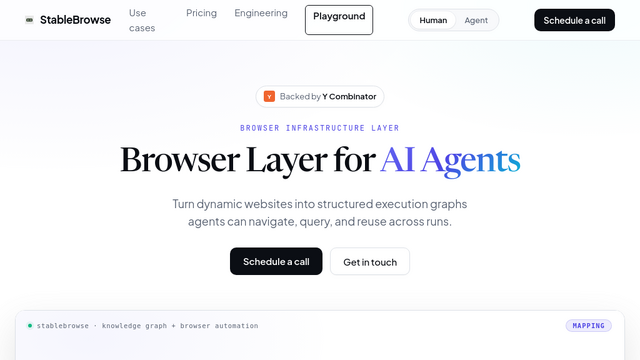
StableBrowse is an advanced, enterprise-grade infrastructure platform backed by Y Combinator (Spring 2026). Specifically engineered to eliminate the high costs and unreliability of traditional visual or DOM-based AI browser agents, StableBrowse acts as a deterministic browser layer. It maps dynamic websites into structured, reusable Knowledge Graphs (capturing page navigation, form fields, and authentication gates), allowing autonomous AI employees to complete back-office work, mortgage indexing, or scraping tasks with up to 80% lower token consumption and a near-perfect success rate.
Use Cases
Automated Back-Office Task Execution
Deploy AI employees to handle repetitive, multi-step workflows like processing loan applications, updating internal CRM records, or managing carrier insurance quotes.
Large-Scale Dynamic Web Scraping
Execute robust data extraction pipelines across modern, heavily protected web properties without worrying about dynamic layout updates breaking your parsers.
Uninterrupted Portal Authentication Management
Run background agent automation loops that seamlessly handle login sessions, credential storage, and multi-factor entry sequences.
API-First Legacy Modernization
Turn legacy enterprise portals or websites that lack official APIs into clean, structured JSON endpoints (supporting REST and WebSockets).
Stoppage Gate Exception Handling
Run end-to-end background operations that run continuously on autopilot until human intervention or a verification approval checkpoint is explicitly required.
Features & Benefits
Deterministic Knowledge Graph Mapping
Converts arbitrary, unpredictable website logic into a strict state-transition map, shifting web navigation from slow LLM visual checks to efficient graph traversal.
Managed Headless Browser Clusters
Includes fully managed headless browser infrastructure designed to optimize speed, memory utilization, and cross-session persistence natively.
Anti-Detection & Residential Proxies
Bundles built-in rotating residential proxy networks, session protection mechanisms, and robust anti-bot bypass logic to prevent rate-limiting or 403 access blocks.
Schema-Driven Precision Extraction
Links custom-defined target schemas directly to specific zones on web nodes, pulling out clean structured data instead of bloated, unorganized HTML fragments.
Universal Custom JSON APIs
Allows developer teams to define their desired data model, outputting ready-to-use JSON feeds directly into their web architectures.
Intelligent Human Escalate Triggers
Automatically flags structural anomalies, major workflow re-designs, or complex policy thresholds, escalating the event to human teams via an audit trail.
Drastic Token & Cost Savings
By calling the LLM to understand intent rather than forcing it to decide where to click next at every individual element, it cuts token costs by 70–80%.
Immunity to UI Redesigns
The underlying schema-first node tracking isolates data points from changing CSS selectors, framework artifacts, or layout modifications.
Bypasses Browser Maintenance Bloat
Completely eliminates the development overhead of setting up private Selenium/Playwright scripts, rotating sessions, and managing proxy setups.
Cons
Requires Upfront Onboarding Configuration
Because the framework shifts away from on-the-fly ‘vibe crawling,’ it requires a setup phase to properly map knowledge graphs and validate initial custom schemas.
Targeted for Complex Scaling
The pricing and infrastructure parameters are built for high-volume enterprise pipelines, which may represent overkill for single-page standalone scripts.