OpenMetadata | Data Discovery, Observability, Governance & Quality
OpenMetadata
Introduction
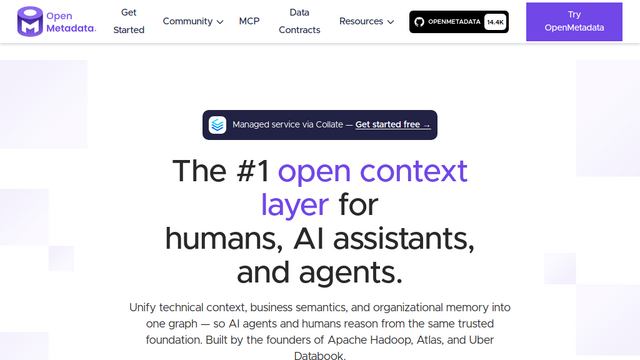
OpenMetadata is an open-source, unified platform designed to manage data discovery, governance, and observability. It provides a centralized interface to catalog data assets, track lineage, monitor data quality, and enforce governance policies across complex data ecosystems, enabling teams to collaborate effectively and trust their data.
Use Cases
Data Discovery
Enables users to easily search and find relevant data assets across the entire organization.
Data Governance
Allows teams to define and enforce policies for data access, ownership, and compliance.
Data Observability
Provides real-time monitoring of data pipelines and health to proactively identify issues.
Data Lineage Tracking
Visualizes the flow of data from source to destination to understand dependencies and impact.
Collaborative Data Management
Facilitates team communication through integrated discussions, announcements, and task management on data assets.
Features & Benefits
Unified Metadata Catalog
Centralizes metadata from databases, BI tools, and data pipelines into a single searchable interface.
Automated Data Profiling
Automatically generates statistics and quality metrics for data assets to ensure reliability.
End-to-End Lineage
Automatically captures and displays data lineage from SQL queries, ETL jobs, and BI dashboards.
Role-Based Access Control (RBAC)
Provides granular security controls to manage who can view or edit specific metadata assets.
Extensible Connectors
Offers a wide array of pre-built connectors for popular data warehouses, lakes, and processing engines.