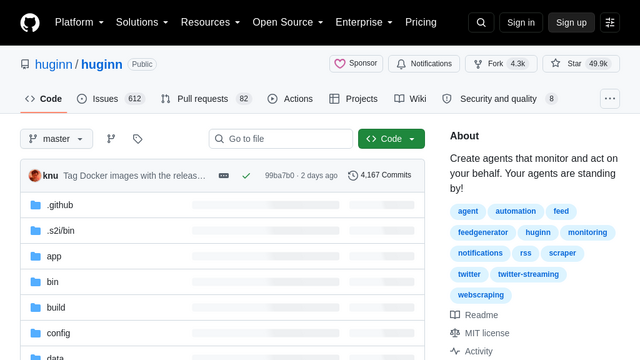
Huginn | Open-Source Self-Hosted Event-Driven Automation & Web Monitoring Agent System
Huginn
Introduction
Huginn is a mature, open-source, MIT-licensed self-hosted automation platform written in Ruby on Rails that lets users deploy autonomous background ‘Agents’ to monitor the web, react to events, and execute actions on their behalf. Often described as a hackable, self-hosted alternative to IFTTT or Zapier, Huginn operates via a directed event graph where modular agents continuously produce, transform, and consume JSON event payloads. Built for complete data sovereignty, it supports website scraping, RSS/IMAP/MQTT monitoring, Liquid templating, JavaScript/jq transformations, and OpenAI-compatible AI text/media processing on private infrastructure without per-task fees.
Use Cases
Website Change Detection & Price/Deal Scraping
Monitor arbitrary web pages using CSS/XPath selectors or headless browsers to detect content changes, price drops, or flight deals and dispatch instant email, Slack, or Telegram alerts.
Custom RSS Feed Aggregation & JSON API Publishing
Ingest messy web pages, filter noise via regex or keyword triggers, and publish clean, private RSS feeds or custom JSON webhook endpoints from collected events.
Event-Driven Inbox, Webhook & IoT Routing
Watch IMAP mailboxes, incoming HTTP webhooks, and MQTT broker topics to chain conditional multi-step reactions across messaging platforms and cloud storage (S3, Dropbox, FTP).
AI-Augmented Summarization & Classification Pipelines
Route scraped articles, social mentions, or alert streams through OpenAI-compatible LLM endpoints to summarize, classify, translate, or generate audio/image digests on a schedule.
Scheduled Digest & Anomaly Spike Notifications
Track high-frequency keyword occurrences or weather/location triggers and send batched daily digest emails or immediate SMS/Twilio escalations when thresholds spike.
Features & Benefits
Directed Event-Graph Agent Architecture
Modular agents act as independent producers and consumers passing structured JSON events along directed dependency graphs with visual graph inspection.
60+ Built-In Specialized Agent Types
Ships out of the box with agents for Website Scraping, RSS, Webhooks, IMAP Email, MQTT, Twilio SMS, Slack, S3/Dropbox, Shell/Bash execution, and OpenAI-compatible AI calls.
Liquid Templating, JavaScript & jq Data Transformation
Provides rich inline payload manipulation using Liquid templates, custom JavaScript functions, and `jq` filters for conditional routing and formatting.
Extensible Ruby Gem Plugin Ecosystem
Supports loading custom community or proprietary agents dynamically as external Ruby gems via the `ADDITIONAL_GEMS` environment variable.
100% Open Source (MIT License) & Self-Hostable
Permissive MIT licensing with zero task quotas or cloud lock-in; deployable via official Docker containers (`ghcr.io/huginn/huginn`) backed by PostgreSQL or MySQL.
Multi-Process Web & Background Worker Separation
Decouples the Rails web management UI from asynchronous background job workers for reliable, continuous 24/7 polling and event propagation.
Total Privacy & Zero Per-Task SaaS Fees
All credentials, scraped data, and event logs remain exclusively on your own server with unlimited agent executions under a permissive MIT license.
Highly Flexible Event-Driven Graph Model
Unlike rigid linear `Trigger -> Action` automations, Huginn’s directed event graph allows fan-out, fan-in, deduplication, and stateful event accumulation across dozens of agents.
Battle-Tested Stability & Extensibility
Over a decade of open-source maturity with a large library of built-in agents and custom Ruby gem extensions.
Cons
Dated UI & JSON-Heavy Configuration UX
Configuring agents relies heavily on editing raw JSON option blocks and Liquid templates inside a classic Rails interface, offering a steeper learning curve than modern visual canvas tools like n8n or Activepieces.
Continuous Polling Resource Footprint
Running dozens of frequent web-scraping and event-monitoring agents requires a persistent VPS/server (typically 1GB+ RAM) with PostgreSQL/MySQL rather than serverless execution.