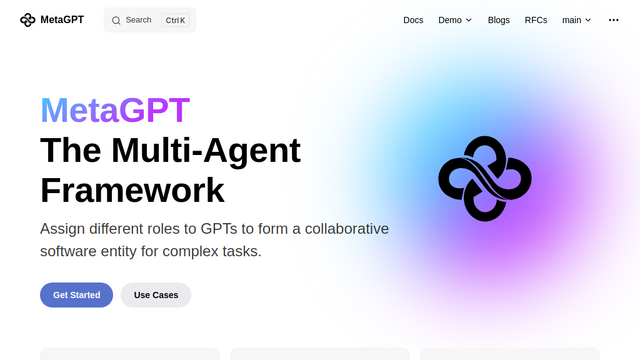
MetaGPT is a sophisticated multi-agent framework that takes a single line of requirement as input and outputs user stories, competitive analysis, requirements, data structures, APIs, and documents. It incorporates human-like Standard Operating Procedures (SOPs) into multi-agent systems, enabling agents to collaborate effectively to solve complex software engineering and data analysis tasks.
Use Cases
Software Development
Automating the end-to-end coding process from requirement analysis to project architecture and implementation.
Data Analysis
Utilizing specialized agents to perform complex data processing, visualization, and insight generation tasks.
Technical Documentation
Automatically generating comprehensive project documentation, including PRDs and system design specifications.
Competitive Research
Conducting automated market and competitive analysis based on user-provided product requirements.
Multi-Agent Orchestration
Building complex collaborative systems where different agents act as product managers, architects, and engineers.
Features & Benefits
SOP Integration
Embeds standardized operating procedures into agents to ensure high-quality, structured output.
Multi-Agent Collaboration
Allows different roles (Product Manager, Architect, Engineer) to communicate and work together on a single codebase.
Code Generation
Capable of producing functional, modular code based on structured architectural designs.
Flexible Framework
Provides a highly extensible environment for developers to define custom agent behaviors and workflows.
Comprehensive Output
Generates a full suite of project artifacts including requirements, data structures, and API definitions.