Wordware | Natural Language Programming IDE & Collaborative AI Agent Builder
Wordware
Introduction
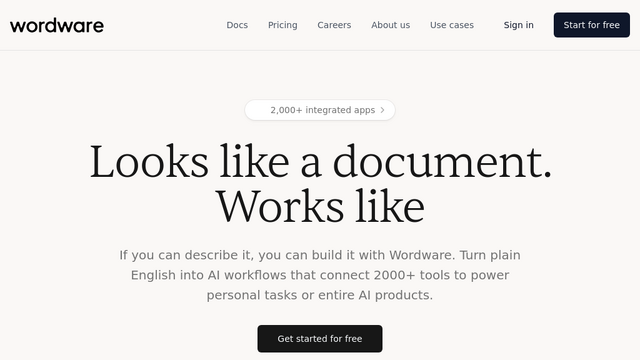
Wordware (YC-backed) is a collaborative, Notion-like integrated development environment (IDE) that treats natural language as the primary programming interface for building AI agents and automated workflows. Instead of requiring developers to wire complex visual node graphs or write heavy backend boilerplate, Wordware allows domain experts and engineers to author agent logic using structured plain English combined with real programming constructs—such as loops, conditional branching, type-safe structured JSON outputs, multi-model orchestration, and custom JavaScript/Python code steps—deployable via a single click as production APIs or embeddable web apps.
Use Cases
Cross-Functional AI Agent Prototyping & Collaboration
Enable product managers, domain specialists, and engineers to co-author, inspect, and iterate on agent prompts and logic in a shared, document-style workspace without wrestling with code repositories.
Multi-App SaaS Workflow Automation (2,000+ Integrations)
Connect LLMs to over 2,000 business tools (CRMs, Slack, databases, web search, voice/audio APIs) to automate end-to-end lead qualification, ticket triage, and research pipelines.
Type-Safe Structured Generation Pipelines
Enforce strict JSON schemas and typed variables across multi-step reasoning chains so downstream applications receive deterministic, machine-readable payloads.
Rapid One-Click API & Web App Deployment
Turn any authored agent workflow into a hosted REST API endpoint or public/embeddable web application instantly without provisioning server infrastructure.
Multimodal Content & Media Orchestration
Chain text, image, audio (e.g., ElevenLabs, Deepgram), and document inputs within a single execution flow for automated content synthesis and assessment.
Features & Benefits
Natural Language Programming (NLP) Document IDE
A clean, block-based editor resembling Notion where plain-English instructions sit directly alongside variables, model calls, and control-flow blocks.
Native Control Flow Primitives (Loops & Branching)
Supports deterministic programming logic—including `if/else` conditionals, `for` loops, sub-flow calls, and error handling—without leaving the text-first canvas.
Multi-Provider Model & Custom Code Orchestration
Mix and match frontier LLMs (OpenAI, Anthropic, Google, open weights) per step while injecting inline JavaScript or Python execution blocks for custom data transformations.
Enforced Structured Outputs (JSON Schema)
Guarantees output schema adherence at each generation step, preventing malformed responses from breaking downstream API integrations.
Built-In Version Control, Tracing & One-Click APIs
Provides diffing, rollback history, step-level execution traces, and instant API key generation for production integration.
Bridges the Gap Between Domain Experts and Engineers
Plain-English authoring allows non-engineers to write and refine prompt logic while engineers retain loops, type safety, and custom code blocks.
Eliminates Visual Node-Graph Spaghetti
Text-first document structure stays readable and easy to version-control compared to sprawling drag-and-drop node canvases as workflows scale in complexity.
Zero-Infrastructure Production Deployment
Moves from prototype to live REST API or shareable web app in one click with built-in execution tracing.
Cons
Proprietary Runtime Lock-In
Workflows authored in Wordware’s custom natural-language syntax are tightly coupled to its hosted IDE and cannot be exported as standalone open-source Python/TypeScript code.
Credit & Execution Scaling Costs
Free starter credits deplete rapidly during multi-step loop testing, and high-volume production runs require paid plans plus underlying LLM token spend.