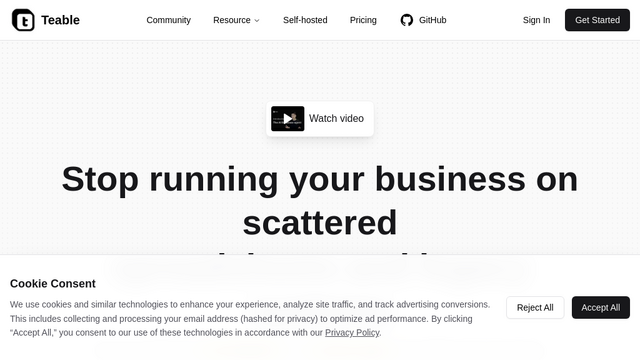
Teable is an open-source, no-code platform built on top of Postgres, offering a spreadsheet-like interface with the power of a professional relational database. It is designed for high performance and scalability, positioning itself as a faster, more flexible alternative to Airtable for both developers and business teams.
Use Cases
Customer Relationship Management (CRM)
Managing sales pipelines, tracking leads, and centralizing client interactions in a structured relational format.
Project and Resource Management
Coordinating complex tasks, timelines, and team workloads with real-time updates and multiple data views.
Inventory and Supply Chain Tracking
Maintaining accurate records of stock levels, suppliers, and logistics with high-performance data processing.
Marketing Content Planning
Organizing editorial calendars, social media schedules, and asset production workflows across departments.
Custom Internal Business Tools
Building bespoke applications tailored to specific company operations without the need for extensive coding.
Features & Benefits
Postgres-Native Architecture
Built directly on PostgreSQL to ensure enterprise-grade data integrity and massive scalability.
High-Performance Engine
Capable of handling hundreds of thousands of rows with minimal latency compared to traditional no-code tools.
Real-time Collaboration
Supports instantaneous synchronization across multiple users to prevent data conflicts and silos.
Open Source & Self-Hostable
Provides full transparency and the ability to host data on private servers for maximum security and privacy.
Developer-Friendly API
Offers comprehensive API documentation and SDKs for easy integration with existing software ecosystems.