SkillSpector | Advanced Security & Vulnerability Scanner for AI Agent Skills
SkillSpector
Introduction
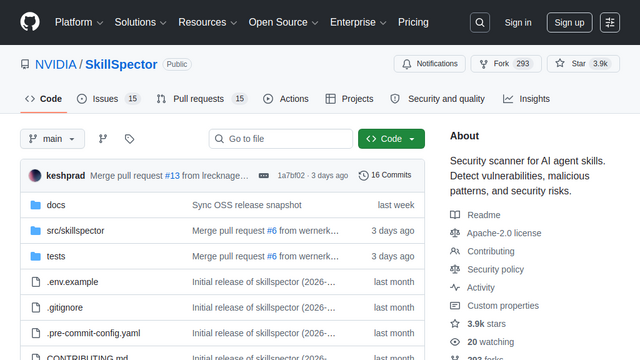
SkillSpector is an open-source (Apache-2.0), LangGraph-backed security analysis tool developed by NVIDIA to proactively scan AI agent execution modules, extensions, and skills (such as those used by Claude Code, Cursor, and similar frameworks). It evaluates agent toolkits for malicious intents, supply chain threats, dependency risks, and permission-escalation vectors before local deployment. Outputting standardized static analysis results (SARIF 2.1.0), JSON maps, or clear Markdown logs, it establishes an automated security gate for agentic environments.
Use Cases
Pre-Installation Security Audits for AI Skills
Scan remote Git URLs, local directories, compressed ZIP files, or markdown files to identify backdoors, unverified code drops, or rogue script commands before loading them into an IDE.
Automated MCP Rug-Pull Detection
Intercept and block malicious Model Context Protocol (MCP) server behaviors designed to execute arbitrary shell payloads or hijack internal system functions.
Enterprise Continuous Integration (CI/CD) Gates
Embed automated scans directly into organizational code channels to systematically block unvetted or untrusted agent skill modules from executing.
Dependency Supply-Chain Threat Assessment
Verify and audit tool-specific dependency declarations within configuration manifests (like pyproject.toml) to prevent dependency confusion attacks and minimize package risks.
Local Air-Gapped Compliance Modeling
Run comprehensive static code analysis entirely on local servers using custom LLM endpoints (like Ollama or private NVIDIA instances) without exposing source frameworks to third-party providers.
Features & Benefits
LangGraph-Based Analytical Workflow Engine
Orchestrates execution steps via a modular LangGraph architecture that passes parsed skill directories through asynchronous, parallel evaluation tracks.
Standardized SARIF 2.1.0 Compliance Output
Produces native Static Analysis Results Interchange Format (SARIF) payloads, allowing vulnerabilities to drop seamlessly into existing enterprise code dashboards.
Multi-Engine Analytical Architecture
Combines fast, zero-token static regular expression pattern checking with downstream LLM meta-analyzers to extract deep contextual semantics and track evasion patterns.
Flexible Cloud & Local LLM Provider Support
Supports multiple backend LLM provider drivers—including Anthropic, OpenAI, AWS Bedrock, Vertex AI, and native NVIDIA Inference endpoints.
Interactive LangGraph Studio Interoperability
Provides a developer mode (make langgraph-dev) that exposes visual data structures, active token use data, and track states inside the LangGraph Studio UI.
Unified Platform Client Interfaces
Accessible via terminal commands (skillspector scan), standard programmatic Python hooks (from skillspector import graph), or dedicated MCP server endpoints.
Prevents Autonomous Agent Takeovers
Provides an essential defensive gate protecting local hardware from rogue agent instructions, untrusted scripts, and shell execution commands.
Highly Modular Architecture Layout
Building the core scanning logic inside a LangGraph framework allows developers to add custom validation rules or domain-specific checklines easily.
Maintains Low Processing Latency
Separating static structural lookups from heavy model assessments keeps scan loops highly responsive and minimizes unnecessary token usage.
Cons
Prone to Document Extraction Noise
Heavy security files or verbose documentation directories can occasionally trigger false positives on normal system rules, requiring fine-tuning of baseline exclusions.
Initial Setup Tracking Latency
Configuring custom environment weights, coordinating individual API tokens, or launching local graph dev environments requires comfortable terminal and Python competency.