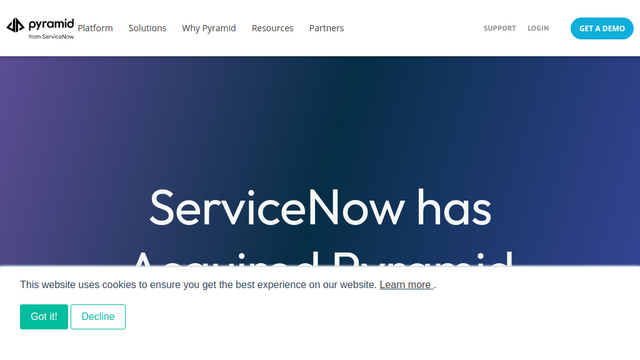
Pyramid Analytics is an institutional-grade Decision Intelligence platform that unifies AI-driven data preparation, virtual semantic modeling, business intelligence (BI), and deep data science into a single, cohesive ecosystem. Positioned as a persistent Visionary in the Gartner Magic Quadrant and officially acquired by ServiceNow in March 2026, the platform bypasses the traditional limitations of disconnected dashboard utilities. By utilizing a high-performance direct-query engine (PYRANA) to eliminate data replication costs across 250+ enterprise sources, Pyramid acts as a trusted, governed abstraction layer that allows multiple corporate personas—from business users to data scientists—to convert unorganized datasets into automated multi-system action workflows.
Use Cases
AI-Driven Semantic Context Assembly
Establish a centralized, enterprise-wide virtual data model that maps standardized definitions and logic formulas securely over disparate corporate databases, eliminating business intelligence drift.
Direct Cross-Cloud / On-Prem Querying
Execute sub-second complex queries and aggregations across massive multi-terabyte data estates directly at the source, completely omitting the cost and data fragmentation of heavy physical warehousing.
Agentic Insight-to-Action Workflows
Leverage deep ServiceNow platform integration to let conversational AI agents run advanced financial or supply chain queries and immediately spin up remediation or routing tickets based on the answers.
No-Code Advanced Data Science Modeling
Allow business analysts to seamlessly drag and drop predictive machine learning layers, custom Python scripts, or R logic blocks directly into live operational data preparation flows.
White-Label Enterprise Embedded Analytics
Inject secure, heavily governed interactive dashboards, tabular reports, and contextual visualization metrics straight into third-party portals or internal web apps using clean API or iFrame code injections.
Features & Benefits
PYRANA Direct Query Optimization Engine
A native, ultra-responsive compute layer that translates visual canvas interactions into heavily optimized, source-specific SQL queries, running live calculations on the database hardware with zero data movement.
ServiceNow AI Platform Integration
Features native orchestration bindings with ServiceNow Workflow Data Fabric, allowing data leaders to bridge enterprise analysis tools directly into automated incident, HR, and facility routing rules.
Conversational Analytics Natural Language Query
Provides an advanced, text-based chat interface allowing users to ask natural questions like ‘Where are we seeing customer churn?’ and instantly generate verified charts and structural copy breakdowns.
Unified Hybrid Workload Distribution
Supports flexible multi-infrastructure topologies, enabling organizations to balance compute costs by running 60–70% of heavy query loads on-premises while leveraging cloud scaling for remote teams.
Granular Multi-Tenant Security & Governance
Includes comprehensive metadata tracking, automated user permission syncs, and clear data lineage paths to support strict enterprise audit criteria (such as SOC 2 and ISO 27001 compliance).
Comprehensive Tiered Support Structures
Offers structured administrative security assurance packages ranging from community forum learning tracks to custom Gold/Platinum priority hotlines and dedicated technical customer portals.
Unifies the Entire Data Lifecycle
Saves enterprise groups from managing separate tools for ETL pipelines, spreadsheet manipulation, visualization, and ML modeling by bundling them into one platform.
Guarantees High AI Context Trust
Providing autonomous agents with a rigid, governed semantic definition layer ensures that automated lookups pull verified corporate numbers rather than hallucinated stats.
Drastic Data Pipeline Cost Reductions
Querying databases directly removes the performance lags, sync errors, and heavy storage overhead commonly tied to building and managing intermediate data cubes or extracts.
Cons
Steep Technical Learning Curve
While the interface features no-code modules, configuring complex multi-source virtual data models and mapping intricate multi-region schemas requires deep database and schema literacy.
Long, Quote-Based Procurement Cycles
The custom, enterprise-centric sales model relies entirely on tailored, quote-based negotiation pathways, adding 3–6 months to deployment timelines compared to standard self-service SaaS tools.