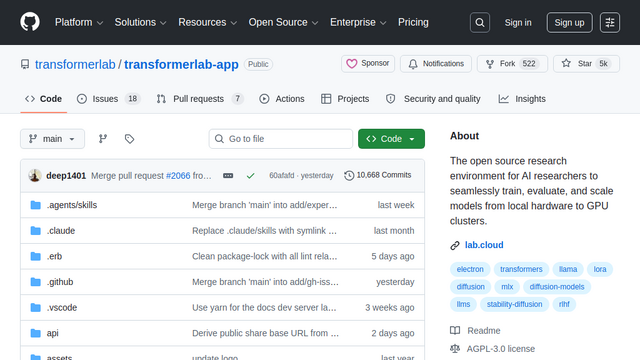
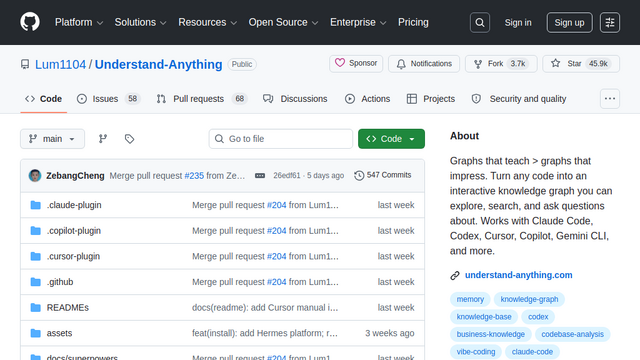
Understand Anything is an incredibly viral, open-source (MIT) developer tool and terminal plugin created by Yuxiang Lin (under the Egonex-AI ecosystem). It solves the problem of ‘codebase amnesia’ on unfamiliar or sprawling repositories by turning massive, text-heavy directories into deeply interactive visual knowledge graphs. Unlike traditional architectural tools that display flat code structures (files and functions), Understand Anything uses a hybrid pipeline combining local tree-sitter precise parsing with a multi-agent LLM reasoning chain. This allows the framework to extract true semantic meaning, automatically mapping raw syntax trees directly into functional business domains, dependencies, and step-by-step guided onboarding tours.
Use Cases
Sub-Minute Legacy Codebase Onboarding
Point the agent at complex, undocumented legacy codebases (up to hundreds of thousands of lines) to quickly understand how the architecture fits together without scanning files blind.
Automated Business Logic Mapping
Translate rigid raw syntax into clear, executive-friendly business layers, instantly tracing where authentication workflows, data mutations, or transaction pipelines sit across separate folders.
Precise Code Change Impact Audits
Run architectural blast-radius checks before hitting commit to see exactly which unexpected downstream modules, API schemas, or test structures will be impacted by your changes.
Deterministic Cross-Language System Reviews
Analyze deeply nested code systems containing multiple mixed structural layouts simultaneously—including Dockerfiles, Terraform scripts, SQL databases, and over 26+ languages.
Zero-Token Interactive Code Exploration
Generate your complete project index once using your active context pool, then search, query, and hop between nodes locally inside a web dashboard with completely zero ongoing API token spend.
Features & Benefits
Dual-Layer Hybrid Parsing Engine
Combines local tree-sitter compiler definitions for ultra-fast, zero-token structural topology tracking with downstream LLMs for rich semantic summarization.
6-Agent Background Analysis Pipeline
Dispatches an orchestration chain of sub-agents that concurrently index directories, cluster community layers, determine entry-point roots, and write plain-English summaries.
Interactive Web-Based TUI Dashboard
Launches a highly responsive, color-coded WebGL graph visualization canvas featuring hierarchical drill-downs, semantic search filters, and live dependency pathfinding.
Multi-Platform Agent Plugin Architecture
Integrates directly into modern developer shells and coding setups, including Claude Code, Codex CLI, Cursor Agent, GitHub Copilot, and Gemini CLI.
Nonlinear Tree-Structured Session Archiving
Saves codebase discoveries and prompt histories within nonlinear branch logs, letting developers pivot to secondary tracking branches without losing context.
Dynamic Code-Diff Visualizer
Includes a dedicated /understand-diff terminal execution filter that surfaces visual change paths and code structural developments instantly.
Unmatched Star Growth Velocity
Exploded from launch to over 70,000+ stars on GitHub within weeks, backed by an extensive global community contributing plugins and custom skills.
Zero Platform Maintenance Lock-In
Distributed entirely as a free, transparent, and MIT-licensed open-source project that runs completely on-device.
Localized Multi-Lingual Outputs
Supports localized outputs across multiple global language profiles (including English, Traditional Chinese, Simplified Chinese, Japanese, and Korean) via single CLI flags.
Cons
Significant Initial Token Investment
The first full codebase index run (/understand) maps every function and file relationship, which can consume a massive count of tokens on giant enterprise projects.
Prone to Large Repo Bottlenecks
Processing large, un-indexed source structures concurrently requires stable background thread limits and solid memory configurations to prevent sub-agent timeout drops.