Spec Kit | Open Source Toolkit for Spec-Driven Development with AI Agents
Spec Kit
Introduction
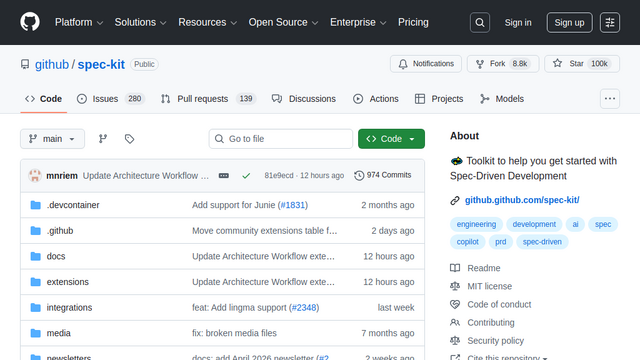
Spec Kit is a highly popular, open-source framework designed to transition AI engineering away from ad-hoc ‘vibe coding’ toward structured Spec-Driven Development (SDD). Instead of prompt-engineering an LLM to blindly generate large chunks of application code in a single turn, Spec Kit establishes a strict, multi-phase engineering pipeline: Constitution → Spec → Plan → Tasks → Implement. By enforcing explicit requirements documentation and cross-artifact consistency analysis, it optimizes context window usage and forces AI coding agents to build predictable, traceable, and thoroughly tested applications.
Use Cases
Greenfield Project Scaffolding (0-to-1)
Establish clear architectural guardrails, structural database schemas, and non-negotiable coding values before an AI agent writes a single line of backend code.
Incremental N-to-N+1 Feature Engineering
Integrate net-new business capabilities into heavy legacy systems by modeling the feature’s requirements in Markdown first, lowering rewrite risks.
Enterprise Engineering Standardization
Enforce uniform organizational presets, compliance matrices, and strict security checklines across engineering groups utilizing AI assistants.
Traceable Continuous-Integration Audits
Commit project specifications, architectural decisions, and task lists directly into Git histories to preserve long-term context for future onboarding.
Multi-Agent Pipeline Integration
Configure automated orchestration networks where specialized requirements agents pass clear task dependencies straight to dedicated execution swarms.
Features & Benefits
Universal 30+ Coding Agent Integrations
Natively compatible out of the box with over 30 leading terminal and IDE-based AI platforms, including GitHub Copilot, Claude Code, Gemini CLI, Windsurf, and Cursor.
Structured Workflow Slash Commands
Exposes a standardized suite of interactive agent commands: /speckit.constitution, /speckit.specify, /speckit.plan, /speckit.tasks, and /speckit.implement.
Specify CLI Python Bootstrapper
A lightweight command-line tool optimized with fast dependency runtimes (like uv or pipx) to seamlessly initialize localized project templates and target integrations.
Automated Ambiguity Resolution Hub
Features a /speckit.clarify engine that uses active, multi-turn sequential questioning to identify missing requirements before coding begins.
Cross-Artifact Alignment Analytics
Includes a /speckit.analyze utility that scans markdown documents to flag tracking discrepancies, such as an implementation plan targeting a table missing from the specification document.
Dynamic Preset & Extension Engine
Allows developer teams to adapt workflows using custom Presets (altering terminology frameworks) or Extensions (injecting third-party tooling like Jira issue syncs).
Drastic Reductions in Token Drift
By compiling discrete, isolated Markdown records for individual phases, it stops conversational bloat and dramatically cuts down on active context token waste.
Ensures Higher Software Predictability
Splitting requirements extraction (‘what’) from the technical choice layer (‘how’) creates clear verification checklines that catch logic flaws early.
Deep Open-Source Adaptation
Boasts over 100k+ stars and an active global contributor network supplying specialized migration pipelines (such as automated enterprise .NET or Java refactoring extensions).
Cons
Requires Strong Engineering Discipline
Teams must resist the impulse to bypass planning steps and dive straight into coding, requiring strict adherence to the multi-phase framework.
Upfront Execution Latency
The initial phases of writing a comprehensive constitution, resolving ambiguities, and tracking task charts add a setup loop before core development starts.