Sense Lab | Persistent Memory & Context Layer for Heterogeneous AI Agents
Sense Lab
Introduction
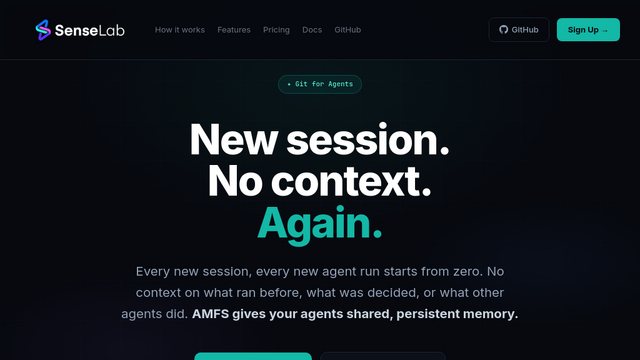
Sense Lab is an advanced AI infrastructure platform designed to solve the critical challenge of context fragmentation in multi-agent ecosystems. It provides a centralized, persistent memory and alignment layer that sits underneath diverse AI agents, frameworks, and automated workflows. By standardizing how past decisions, rationales, and execution histories are recorded and retrieved, Sense Lab enables different autonomous agents to seamlessly hand off complex, long-horizon tasks to one another while preserving absolute context continuity.
Use Cases
Cross-Framework Agent Handoffs
Allow a coding agent built in LangGraph to pass a completed deployment task over to a monitoring agent built in CrewAI or n8n without losing the contextual rationale behind specific code changes.
High-Frequency Customer Support Triage
Automate Level-1 and Level-2 support ticketing by resolving repetitive issues autonomously while dynamically routing edge cases to human reps with a complete, structured history of the agent’s reasoning.
Long-Horizon Software Engineering
Manage multi-day background programming cycles across separate execution environments (like isolated tmux windows or dev containers) by logging granular task states and explicit verification receipts.
Strategic Corporate Memory Aggregation
Build an enduring, company-wide knowledge base that captures not just finalized documents, but the iterative decision-making logic of AI agents handling daily operations.
Deterministic Human-in-the-Loop Interventions
Enforce strict automated checkpoints where an agent must pause upon verification failure and present a clear ‘receipt’ of its actions for a human developer to audit and override.
Features & Benefits
Shared Memory Context Layer
A unified, persistent storage engine that acts as a continuous source of truth for all active agents, eliminating context window bloat and cross-session amnesia.
Execution Receipt Protocol
Forces agents to output structured telemetry records after every loop execution detailing exactly what changed, what tests ran, where it failed, and what requires human review.
Granular Task Isolation & Anti-Collision
Optimizes multi-agent swarms by enforcing strict operational boundaries (one agent per sub-task/branch), preventing context mixing or overlapping writes.
Deterministic Loop Halting
A safety-critical orchestration rule that instantly freezes an agentic loop upon a failed validation step, feeding the precise error back into the memory log rather than allowing unchecked hallucinations.
Pluggable Ecosystem Connectors
Exposes flexible endpoints and API webhooks that allow custom scripts, enterprise CLI tools, and automation node systems to read and write to the shared context database.
Eliminates AI Hand-off Friction
Solves the ‘black box’ problem of multi-agent collaboration by ensuring the next agent in a pipeline fully understands *why* a previous action was taken.
High Operational Predictability
By replacing ‘vibe coding’ chains with explicit execution receipts and strict exit criteria, it makes long-running autonomous processes safe and auditable.
Massive Cognitive Overhead Reductions
Developers or managers can audit a multi-hour autonomous run in seconds by scanning highly structured text receipts rather than parsing thousands of lines of raw chat logs.
Cons
Requires Rigorous Workflow Discipline
The framework requires developers to structure tasks into tightly scoped, isolated chunks with explicit acceptance criteria to reap maximum performance.
Infrastructure Complexity
Setting up a centralized memory layer beneath a diverse set of local and cloud-based automated tools adds a structural configuration tier that must be maintained.