Open Design | The Vibe Design Workspace & Open-Source Claude Design Alternative
Open Design
Introduction
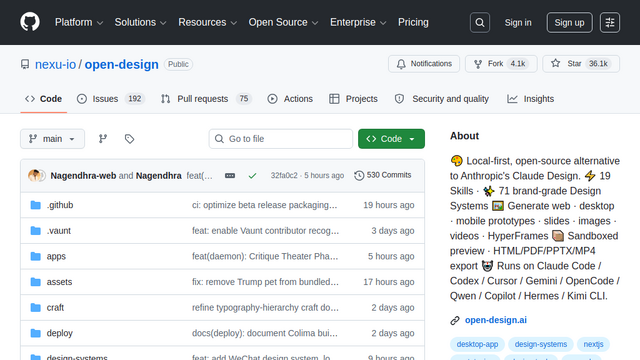
Open Design is a local-first, open-source (Apache-2.0) AI design intelligence platform engineered as an alternative to Anthropic’s Claude Design. Rather than shipping its own proprietary agent or model, Open Design acts as an orchestrator layer. It automatically scans your local PATH variable to detect existing coding-agent CLIs (such as Claude Code, Codex, Cursor Agent, Gemini CLI, OpenCode, or Qwen) and turns them into high-fidelity design engines. Driven by a filesystem of modular Skills and portable Markdown-based Design Systems, it guides AI agents to output production-grade, brand-aligned interfaces rather than generic AI slop.
Use Cases
Interactive Prototyping (Web/Desktop/Mobile)
Instruct your local coding agent to build sandboxed web, mobile, or desktop interface prototypes complete with interactive elements, responsive grids, and logic.
Automated Brand Design System Application
Enforce strict corporate identity rules over AI outputs by forcing models to pull parameters directly from a localized brand contract file (DESIGN.md).
Instant Production Deck & Presentation Generation
Convert raw project briefs or outlines into styled, magazine-grade slide decks featuring advanced WebGL elements and immediate multi-format presentation downloads.
HyperFrames Motion Graphics Assembly
Develop programmatic video assets and micro-interactions by converting structured data, HTML, and CSS directly into native MP4 animations on your machine.
API-Driven Design Automation
Leverage the local background HTTP daemon to programmatically schedule, script, and trigger repetitive design workflows or asset generation tasks inside a local CI/CD loop.
Features & Benefits
Agent-Native & Model-Agnostic Core
Scans and auto-detects over 13+ locally configured agent CLIs natively, letting you swap your underlying reasoning model with a single click in the UI.
Portable Markdown Design Systems
Includes over 70+ built-in, brand-grade configurations (e.g., Stripe, Linear, Vercel, Apple) powered entirely by a 9-section DESIGN.md layout specifying palettes, type, spacing, and anti-patterns.
Modular Skill Execution Filesystem
Features a decoupled library of 19+ pre-configured behavioral parameters (defined via SKILL.md) tracking everything from landing pages and data dashboards to PRD documents.
Interactive Discovery Guardrails
Forces the AI to halt and present a structured question form, visual direction picker, and interactive TODO checklist before generating a single pixel.
Local-First Daemon & Storage (SQLite)
Runs completely offline via a local Node/Express daemon, keeping conversations, workspaces, and project directories locked securely on-device within a local SQLite database.
Sandboxed Preview & Multi-Format Export
Renders live code updates inside an isolated iframe preview, offering one-click clean asset compiling to HTML, PDF, PPTX, MP4, and structural ZIP archives.
Zero Third-Party Vendor Lock-In
Provides a highly transparent, free alternative to closed-source design sandboxes while letting you utilize the exact local CLI tools you already pay for.
Rigid Prompt Slop Mitigations
By forcing models through a 5-dimensional self-critique loop and strict P0/P1/P2 execution checklists, it guarantees clean, structured production assets.
Complete Data Privacy
Operating entirely as a local-first application with zero forced telemetry, your sensitive project assets, keys, and internal brand parameters never leave your local drive.
Cons
Upfront Technical Environment Overhead
Requires basic terminal comfort, Node/pnpm runtimes, and pre-installed coding agent CLIs to build and pair the local daemon workspace successfully.
Not Ideal for Manual Vector Artistry
Built from the ground up for agentic code-driven asset layout generation; it is not a direct substitute for collaborative manual vector design suites like native Figma.