
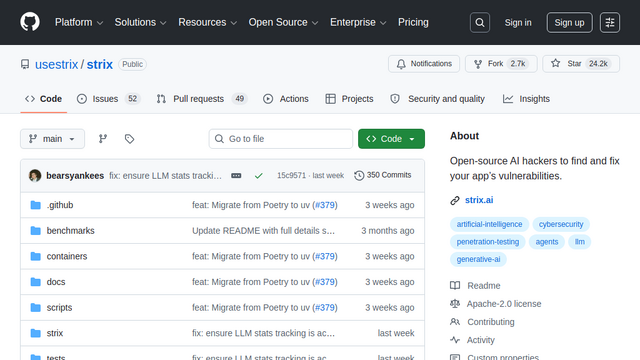
Strix is an autonomous, agentic security platform designed to function as a ‘team of AI hackers’ that find and fix vulnerabilities in modern applications. Unlike traditional scanners that rely on static signatures, Strix uses advanced LLM-based reasoning to plan, investigate, and validate security issues end-to-end. It mimics the workflow of a human penetration tester—discovering endpoints, crafting payloads, and generating verified Proof-of-Concepts (PoCs) to ensure zero false positives, all while integrating directly into developer workflows and CI/CD pipelines.
Use Cases
Automated Penetration Testing
Run exhaustive security audits on web apps and APIs in hours instead of weeks, receiving a professional-grade report with actual exploit code.
CI/CD Security Guardrails
Integrate Strix into GitHub Actions to scan every pull request for vulnerabilities like IDOR or SQLi, blocking insecure code before it reaches production.
Bug Bounty Automation
Automate the tedious reconnaissance and initial exploitation phases of bug hunting, allowing researchers to focus on complex logic flaws.
White-Box Code Analysis
Provide agents with repository access so they can cross-reference static code patterns with dynamic runtime behavior for deeper vulnerability discovery.
Rapid Remediation & Auto-Fixing
Use the ‘one-click autofix’ feature to have Strix generate a ready-to-merge pull request that patches the specific vulnerability it just discovered.
Features & Benefits
Hierarchical Multi-Agent Swarm
Orchestrates specialized agents (Manager, Recon, Exploit, Reporter) that collaborate in parallel to map attack surfaces and chain exploits.
Mandatory PoC Validation
Every reported vulnerability comes with a verified Proof-of-Concept script or recording, proving the issue is real and reproducible.
Hacker Toolkit Integration
Natively wraps and orchestrates industry-standard tools like nmap, ffuf, sqlmap, and Nuclei through an agentic reasoning loop.
Interactive Terminal UI (TUI)
A high-fidelity dashboard that shows agent ‘thinking’ blocks, real-time command outputs, and live vulnerability counts during a scan.
LLM-Based Deduplication
Automatically merges semantically similar findings into a single canonical report to reduce noise and alarm fatigue for developers.
Zero Data Retention Architecture
Designed for privacy-conscious teams; source code is never stored or used for model training, and the environment is entirely ephemeral.
High-Signal Reports
By requiring a successful exploit (PoC) before reporting, Strix effectively eliminates the ‘false positive’ noise common in legacy DAST tools.
Massive Cost Savings
A deep scan typically costs $10–$20 in API tokens, representing a ~99% reduction in cost compared to manual third-party penetration tests.
Developer-Centric UX
The CLI/TUI focus and ‘autofix’ capability make security feel like a native part of the development process rather than a separate, slow compliance hurdle.
Cons
Token Consumption
Deep, exhaustive scans can consume significant LLM tokens (API costs), requiring users to monitor their `STRIX_REASONING_EFFORT` settings.
Ethical Responsibility
As a powerful ‘hacking’ tool, it requires strict adherence to legal boundaries; it should only be used on targets where the user has explicit permission to test.