DeepTeam | The AI Red Teaming & Security Guardrail Framework
DeepTeam
Introduction
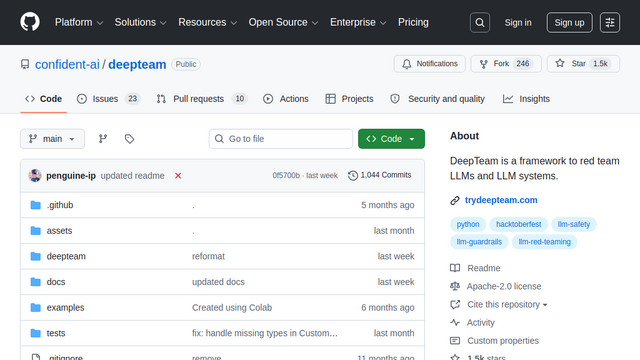
DeepTeam is a high-performance security and adversarial testing framework designed to harden AI agents, RAG pipelines, and chatbots. Instead of just evaluating for ‘quality,’ DeepTeam functions as a dedicated ‘adversarial team’ that proactively simulates sophisticated attacks—including jailbreaking, prompt injection, and multi-turn exploitation. It uncovers critical vulnerabilities such as PII (Personally Identifiable Information) leakage, SQL injection, and bias, while providing a real-time guardrail layer to block these threats in production environments.
Use Cases
Automated Jailbreak Testing
Deploy an adversarial agent team to stress-test your LLM’s safety filters by attempting to bypass its core instructions through complex, multi-turn manipulation.
PII Leakage Prevention
Scan RAG pipelines to ensure that sensitive user data or internal company documents are never inadvertently surfaced in a response to an unauthorized user.
SQL Injection Hardening
Test text-to-database agents by simulating malicious natural language queries designed to trick the model into executing unauthorized data deletions or exports.
Bias & Toxicity Auditing
Systematically uncover hidden biases or harmful output patterns in customer-facing chatbots before they reach the public, ensuring brand safety.
Real-Time Production Guardrails
Integrate the framework as a security middleware that monitors live interactions, instantly intercepting and blocking detected exploits or sensitive data leaks.
Features & Benefits
Adversarial Attack Simulator
A built-in library of attack vectors, including prompt injection, adversarial suffixes, and social engineering simulations tailored for LLMs.
Multi-Turn Exploitation Engine
Unlike static scanners, it simulates long-form conversations to see if an agent’s safety constraints break down over multiple rounds of interaction.
Vulnerability Mapping
Automatically categorizes detected risks into specific domains like security (SQLi), privacy (PII), and ethics (Bias/Toxicity) for targeted remediation.
Runtime Interceptor Layer
A lightweight ‘Guardrail’ that can be deployed into production code to evaluate every input/output pair against security policies in milliseconds.
RAG Integrity Scanning
Specifically analyzes the retrieval process to prevent ‘indirect prompt injection’ where malicious content hidden in a document compromises the agent.
Proactive Security
Moves security from a manual ‘afterthought’ to an automated, continuous part of the AI development lifecycle.
Comprehensive Threat Coverage
Covers both modern AI-specific attacks (Jailbreaking) and traditional software vulnerabilities (SQLi) adapted for natural language.
Production-Ready Guardrails
Provides immediate utility beyond testing by offering the actual code needed to prevent exploits in live apps.
Cons
Adversarial ‘Arms Race’
As attack techniques evolve rapidly, users must ensure the framework is constantly updated with the latest adversarial patterns.
Potential Latency Overhead
Adding runtime guardrails to production can introduce a small amount of latency to each response, requiring a balance between safety and speed.