
Unsloth | 2x Faster LLM Training with 70% Less VRAM
Unsloth
Introduction
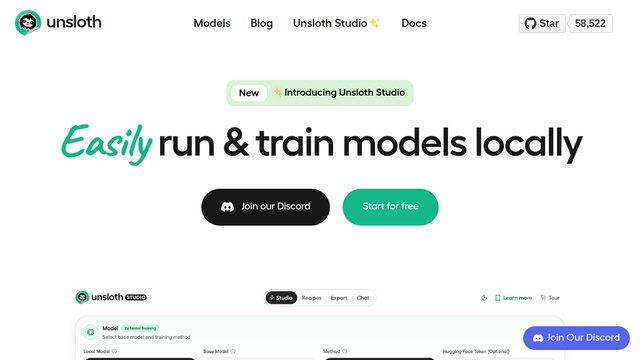
Unsloth is a high-performance open-source framework and desktop application (Unsloth Studio) dedicated to making the fine-tuning and execution of Large Language Models (LLMs) significantly faster and more accessible. By implementing custom Triton and CUDA kernels, Unsloth allows developers to train models like Llama 4, Qwen 3.5, and Gemma 4 with up to 70% less memory usage and zero accuracy loss. It bridges the gap between massive data-center hardware and consumer GPUs, enabling professional-grade AI development on a single RTX 30/40/50 series card.
Use Cases
Consumer-Grade Fine-Tuning
Train 7B to 30B parameter models on a single 24GB VRAM GPU (like an RTX 4090) that would normally require enterprise-grade A100/H100 hardware.
Reasoning Model Training (GRPO)
Train DeepSeek-R1 style ‘thinking’ models using only 5GB of VRAM, making advanced reinforcement learning accessible to individual researchers.
Automated Dataset Creation
Use ‘Data Recipes’ to automatically transform raw PDFs, CSVs, and documents into high-quality synthetic instruction datasets via a visual graph-node workflow.
Long-Context Adaptation
Fine-tune models with 60k+ token context windows on a single 80GB GPU, facilitating deep analysis of entire books or massive codebases.
Private Local Inference
Run GGUF or safetensor models 100% offline with self-healing tool calling, web search, and code execution (Python/Bash) integrated into the local UI.
Features & Benefits
Unsloth Studio (Web UI)
A unified local interface for no-code training, observability, and side-by-side model comparison (Model Arena).
Custom Mathematical Kernels
Hand-written kernels for LoRA, QLoRA, and attention mechanisms that eliminate memory fragmentation and accelerate the backward pass.
Multi-Modality Support
Optimized training paths for not just text, but also vision, audio (TTS), and embedding models.
Reinforcement Learning (RL) Optimization
The industry’s most efficient RL library, reducing VRAM usage for GRPO and PPO by up to 80%.
Dynamic 4-bit Quantization
Maintains perplexity within 0.02 points of 16-bit baselines while significantly lowering the memory barrier for training.
Unrivaled Speed
Consistently benchmarks 2x to 5x faster than standard PyTorch or Hugging Face implementations for single-GPU training.
High Hardware Compatibility
Support for NVIDIA (RTX/DGX), Intel (Arc/Max), and emerging support for Apple MLX and AMD.
Sovereign Privacy
Unlike cloud-based trainers, Unsloth Studio can run entirely offline with no usage telemetry collected.
Cons
Single-GPU Limitation (OSS)
The free open-source version is restricted to single-GPU training; multi-GPU and multi-node setups require the Pro or Enterprise tiers.
Technical Learning Curve
While the Studio simplifies things, deep customization still requires familiarity with Python and training hyperparameters like learning rates and rank (R).