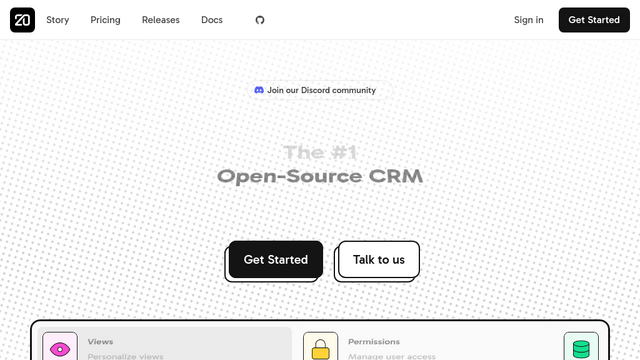
Twenty is a modern, open-source CRM (Customer Relationship Management) platform designed to be a flexible and customizable alternative to proprietary solutions like Salesforce and HubSpot. It empowers businesses with full control over their data, offers a sleek user interface, and is built on a community-driven model, allowing deep customization and integration into existing tech stacks.
Use Cases
Sales Pipeline Management
Streamline the sales process by tracking leads, opportunities, and customer interactions from initial contact to conversion.
Customer Data Centralization
Consolidate all customer information in one place, providing a unified view for better customer relationship management and personalization.
Custom Business Workflows
Adapt the CRM to unique business processes and data models without extensive coding, fitting specific industry or organizational needs.
Data Ownership and Privacy
Ideal for businesses that require self-hosting capabilities to maintain complete control, security, and privacy over their sensitive customer data.
Integration and Automation
Utilize its robust API and webhooks to integrate with other business tools and automate workflows, enhancing operational efficiency.
Features & Benefits
Open-Source & Self-Hostable
Gain complete control over your data infrastructure, eliminate vendor lock-in, and ensure data privacy and security.
Modern User Interface (UI/UX)
Benefit from an intuitive and aesthetically pleasing design that simplifies user adoption and enhances productivity for teams.
Customizable Data Models
Tailor the CRM by creating custom fields, objects, and relationships to perfectly match your specific business requirements and workflows.
Powerful API & Webhooks
Seamlessly connect Twenty with your existing software ecosystem, enabling data synchronization and workflow automation across platforms.
Community-Driven Development
Leverage ongoing improvements, bug fixes, and feature additions contributed by a global community of developers, ensuring continuous evolution and support.
Full Data Ownership
Self-hosting options ensure businesses retain complete control and privacy over their sensitive customer data.
High Customization Potential
The open-source nature and flexible architecture allow for deep customization to fit unique business processes and data models.
Cost-Effective Long-Term
Eliminates recurring per-user license fees, potentially offering a lower total cost of ownership for larger teams willing to manage their infrastructure.
Transparent Development
The open-source model provides transparency into the codebase and allows for community contributions and audits.
Cons
Requires Technical Expertise
Self-hosting and extensive customization can demand significant technical knowledge and IT resources for deployment and maintenance.
Reliance on Community Support
While a community exists, dedicated enterprise-grade support with SLAs might not be as readily available as with commercial SaaS solutions.
Feature Maturity
As a relatively newer open-source project, some advanced features found in established proprietary CRMs may still be under development or less refined.
Initial Setup Overhead
The initial setup and configuration process for a self-hosted instance can be more time-consuming than simply signing up for a cloud-based SaaS.