Taipy | The Open-Source Low-Code Library to Build Powerful Data & AI Apps
Taipy
Introduction
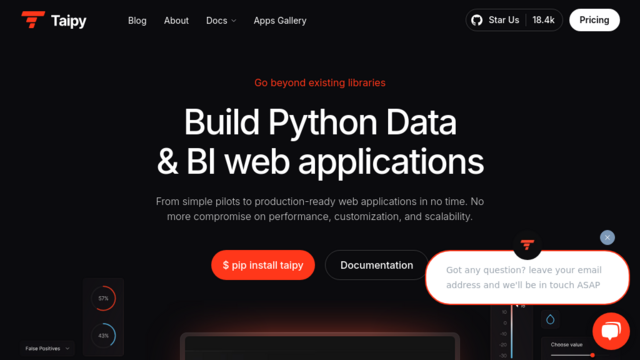
Taipy is an open-source low-code Python library designed to help data scientists and developers quickly build powerful data and AI applications. It simplifies the creation of full-stack web applications, dashboards, and interactive scenarios by providing tools for data management, scenario management, and intuitive graphical user interface (GUI) development, all within a pure Python environment.
Use Cases
Building Interactive Dashboards
Quickly create dynamic and interactive data dashboards for business intelligence and data visualization.
Developing AI/ML Frontends
Design user-friendly interfaces for machine learning models, allowing users to interact with and understand AI predictions.
Managing Complex Scenarios
Develop applications that handle multiple data versions, simulations, and scenarios, ideal for ‘what-if’ analyses in operations or finance.
Prototyping Data Applications
Rapidly prototype and iterate on data-driven applications without extensive web development knowledge.
Operationalizing Data Pipelines
Integrate data processing pipelines with user interfaces, making it easier to monitor, manage, and interact with data flows.
Features & Benefits
Low-Code Python API
Enables rapid application development using pure Python, significantly reducing the amount of code required.
Integrated GUI Builder
Provides intuitive components for building interactive user interfaces directly from Python, abstracting away web complexities.
Scenario Management
Allows users to define, manage, and switch between different data versions or simulation scenarios within an application.
Data Pipeline Orchestration
Offers tools to define and execute data processing pipelines, ensuring data freshness and consistency.
Open-Source & Extensible
Being open-source, it offers transparency, community support, and the flexibility to extend its functionalities as needed.
Pure Python Development
Eliminates the need for front-end web development skills, allowing data scientists to build full-stack apps.
Rapid Prototyping
Speeds up the development of data and AI applications from concept to deployment.
Scenario Management Capabilities
Excellent for applications requiring ‘what-if’ analyses and management of multiple data states.
Strong Community Support
As an open-source project, it benefits from community contributions and support.
Cons
Python Ecosystem Dependency
Users are tied to the Python ecosystem, which might not suit all enterprise environments.
Learning Curve for Advanced Features
While low-code, mastering advanced customization or complex scenario management might require a learning investment.
Maturity Compared to Established Frameworks
As a newer framework, it might not have the same breadth of integrations or long-term stability as older, more mature solutions.