SkillsMP | The Open Agent Skills Marketplace & Discovery Engine
SkillsMP
Introduction
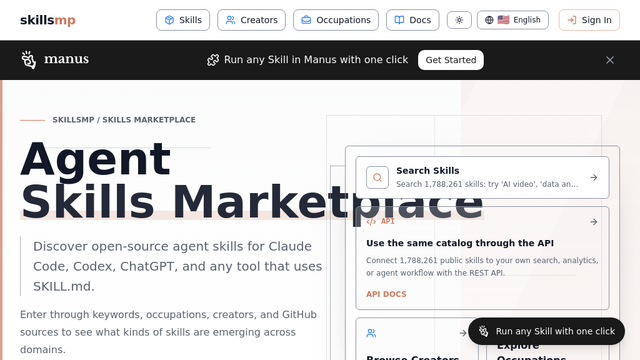
SkillsMP is the internet’s largest decentralized, open-source registry and discovery engine for modular AI ‘Agent Skills.’ Engineered specifically to phase out long, messy prompt-engineering templates, the platform structures operational logic into the open standard SKILL.md format. By serving as an advanced, cross-modal indexing crawler over millions of public GitHub repositories, SkillsMP maps and translates raw multi-language scripts, terminal commands, and system context guidelines into bite-sized, version-controlled capabilities that AI agents can intelligently invoke on-demand.
Use Cases
Domain-Specific AI Agent Augmentation
Discover and hot-load precise vertical capabilities—such as detailed blockchain indexers, financial report parsers, or SEO audit loops—directly into your active AI developer session.
Zero-Bloat Token Context Management
Eliminate prompt context window saturation by shifting from heavy 10,000-token system prompts to a progressive disclosure setup where the agent fetches structural script tasks only when triggered.
Cross-Language Workflow Automation Syncing
Standardize development steps across large, mixed engineering teams, enabling AI assistants to uniformly handle complex database migrations or continuous integration tasks regardless of the host IDE.
Deep Open-Source Security & Leak Audits
Scan, analyze, and cross-reference public repository code structures before deployment to proactively catch and block hidden credential leakage, debug logs, or toxic cross-modal injections.
Inter-Agency Occupation Map Discovery
Browse structured skill arrays mapped directly to 23 unique global standard occupation classifications (SOC) to study how adjacent professional fields structure their analytical processes for machine-execution.
Features & Benefits
Massive 420K+ Agent Skill Repository Index
Maintains a massive, dynamically updated technical index tracking thousands of open-source automation modules across categories like Testing, DevOps, Data & AI, and Content.
Open SKILL.md Specification Alignment
Enforces a uniform structure pairing YAML-based capability manifests (mapping target names, descriptions, and boundaries) with underlying executable Python, TypeScript, Node, or Bash scripts.
Universal Cross-Agent Compatibility Matrix
Natively engineered to seed composable skills into leading terminal assistants, model lines, and visual development systems (including Claude Code, Cursor, Windsurf, OpenCode, and Antigravity).
Intelligent Cloudflare-Backed Semantic Search
Features high-velocity natural language processing paths and deep API filters allowing users to locate domain-specific actions by author, repository stars, tag updates, or execution permissions.
Unified Local Integration CLI Toolchain
Leverages standardized npx wrappers (such as add-skill and skills-runner) alongside direct ZIP exports to download and load skills locally into global project paths with single commands.
Dedicated Native Research Plugins
Integrates deep project-path analysis scripts directly inside agent consoles to scan active software structures and automatically suggest optimized workflow skill combinations.
Drastic Reductions in Prompt Maintenance
Saves developers from copy-pasting the same instructions repeatedly across separate chats by turning reusable expertise into an interactive utility list.
Completely Free & Unaffiliated Core Environment
Operates as an independent community repository with zero vendor-lock boundaries or platform-exclusive paywalls.
Seamless Cross-Model Portability
Because it relies on file-based markdown maps and native terminal shells, skills migrate effortlessly when hot-swapping between behind-the-scenes models.
Cons
Requires Diligent Source Verification
As an open database crawling public code, users must evaluate individual repository trust anchors and file access scopes to avoid malicious downstream injection vectors.
Node.js and Environment Dependencies
Executing and integrating these modular components cleanly inside local terminals relies on a properly configured local Node.js engine and active shell path mapping.