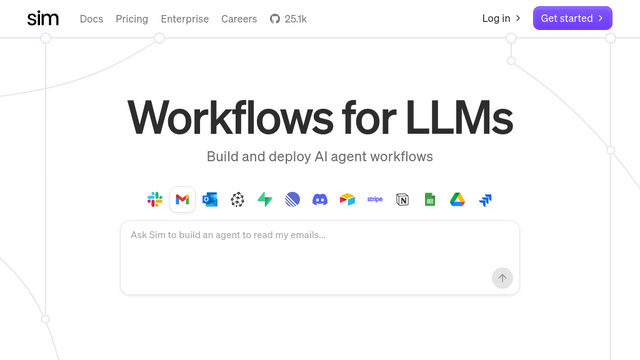
Sim AI (also known as Sim Studio) is an open-source, visual workflow builder designed for creating and deploying sophisticated AI agent systems. Often described as the ‘Figma for AI workflows,’ it provides a drag-and-drop canvas where developers and teams can connect LLMs, databases, and over 100 third-party apps to build intelligent automation. Unlike traditional linear automation tools, Sim AI focuses on multi-agent collaboration, enabling specialized AI agents to reason, interact with tools, and work together in complex, branching production environments.
Use Cases
Automated Customer Support:
Build AI agents that can access internal knowledge bases and ticketing systems to resolve customer inquiries autonomously.
Content Generation Pipelines:
Create a multi-agent team (Researcher, Writer, Editor) to produce high-quality, fact-checked articles or social media posts.
Sales Operations Automation:
Manage the entire lead lifecycle by automating personalized email outreach, scheduling, and CRM updates.
Intelligent Data Processing:
Orchestrate workflows that extract insights from documents, perform real-time analysis, and synchronize data across various business platforms.
Custom Chatbot Development:
Deploy conversational AI assistants integrated with tools like Slack, Gmail, or WhatsApp to handle specific business logic.
Features & Benefits
Visual Drag-and-Drop Canvas:
A design-first interface built on a Directed Acyclic Graph (DAG) model for mapping non-linear, branching agent logic.
Agentic Co-pilot:
An AI assistant integrated into the builder that allows users to generate or modify entire workflows using natural language commands.
Multi-Agent Orchestration:
Support for systems where multiple specialized agents collaborate, sharing context and making collective decisions.
Extensive Integration Library:
Native connections to 100+ services including OpenAI, Anthropic, Gemini, local models (Ollama), Slack, Notion, and Pinecone.
Hybrid Deployment Options:
Users can choose between a fully managed cloud-hosted version at sim.ai or self-hosting via Docker and Kubernetes for total data control.
Open Source & Free Entry:
Offers a powerful free tier and an open-source codebase, making enterprise-grade automation accessible to everyone.
Extreme Flexibility:
Allows users to bring their own API keys and choose different LLM models for each specific node or agent.
Real-Time Observability:
Provides built-in monitoring and debugging tools to inspect data flow and agent reasoning in production.
Cons
Overage Complexity:
While it includes a base usage allowance, heavy workloads incur incremental overage charges that may require careful monitoring.
Learning Curve:
Despite the visual interface, designing effective multi-agent logic requires a fundamental understanding of prompt engineering and workflow architecture.