Portkey | Enterprise AI Gateway, Observability & Guardrails Platform
Portkey
Introduction
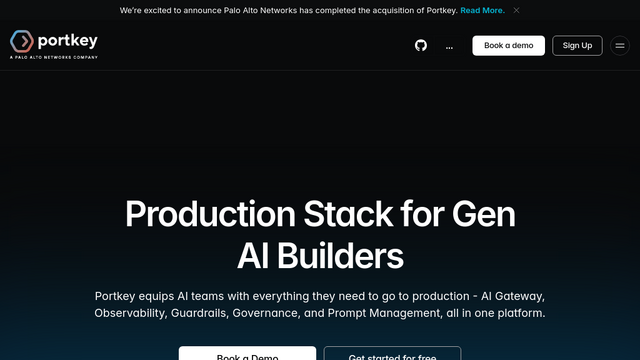
Portkey.ai is a production-grade AI Gateway and LLMOps control plane designed to help engineering teams build, deploy, and scale LLM-powered applications reliably. Serving as an open-source, ultra-fast middleware layer (<1ms latency overhead), Portkey unifies routing across 1,600+ AI models, automatic retries and fallbacks, real-time observability, budget/rate governance, prompt engineering, and security guardrails behind a single OpenAI-compatible API.
Use Cases
High-Availability Multi-LLM Failover
Eliminate application downtime by automatically routing traffic across backup providers (e.g., failing over from OpenAI to Anthropic or Azure) whenever primary API endpoints experience rate limits or outages.
Enterprise AI Cost & Latency Observability
Track token consumption, request latencies, and total spend across models, teams, and environment environments with granular tracing down to individual prompt turns.
Real-Time Input/Output Guardrails
Enforce strict security policies by automatically detecting and redacting Personally Identifiable Information (PII), blocking prompt injection attacks, and filtering unsafe content before hitting LLM endpoints.
Centralized Prompt & Agent Management
Version control, test, and deploy prompts dynamically without redeploying application code, while governing tool calls and Model Context Protocol (MCP) server traffic.
Smart Load Balancing & Semantic Caching
Distribute high-volume request loads across multiple deployment keys and cache repeated prompt responses to slash LLM API expenses and latency.
Features & Benefits
Ultra-Fast Open-Source AI Gateway
A lightweight Node.js engine (<1ms latency overhead, ~122KB footprint) that standardizes API calls to 1,600+ text, vision, audio, and image models across 40+ providers.
Comprehensive Observability & Tracing
Full-stack monitoring capturing inputs, outputs, function calls, latency metrics, and costs, integrated directly with OpenTelemetry standards.
50+ Modular Security Guardrails
Pre-built and custom guardrails for PII masking, toxicity checking, regex validations, structured output enforcement, and hallucination metrics.
Enterprise Governance & Access Controls
Granular Role-Based Access Control (RBAC), virtual key management, org-wide budget caps, and multi-tenant isolation profiles.
Model Context Protocol (MCP) Gateway
Natively manages and secures MCP server connections with enterprise authentication, audit logging, and traffic controls.
Dynamic Prompt Management & A/B Testing
A centralized prompt workspace with variable templates, prompt versioning, and live canary deployments for continuous optimization.
Drastic Fallback & Resilience Boost
Ensures near-100% operational uptime for mission-critical AI applications via automated, configurable retry logic and provider routing rules.
OpenAI SDK Interoperability
Requires changing only two lines of code (`baseURL` and `defaultHeaders`) to integrate into existing codebases built on standard OpenAI SDKs.
Self-Hostable & Open Source
The core gateway layer is open-source, allowing teams to run the routing layer on their own infrastructure for total data sovereignty.
Cons
Operational Overhead at Massive Scale
Managing self-hosted gateway clusters across multi-region environments requires solid Kubernetes and DevOps expertise.
Complex Pricing Tier Matrix
While the open-source gateway is free, advanced cloud features like enterprise guardrails, log retention, and SSO depend on hosted tier allocations.