
Paperclip | Open-source orchestration for zero-human companies
Paperclip
Introduction
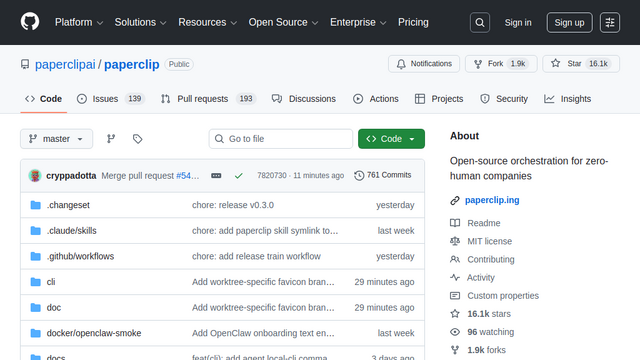
Paperclip is a state-of-the-art open-source platform designed to orchestrate teams of autonomous AI agents as a ‘virtual company.’ Built on Node.js and React, it provides a comprehensive management layer—including org charts, budgets, and governance—to coordinate various coding and task-based agents like Claude Code, Codex, and Cursor. It aims to transform the concept of ‘vibe coding’ into a professional business operations framework, allowing users to assign high-level goals and track execution, costs, and progress from a centralized dashboard.
Use Cases
Autonomous Software Development
Coordinate a team of AI agents (e.g., Cursor, OpenCode, and Pi) to handle feature development, PR reviews, and bug fixes in a shared codebase.
Zero-Human Business Operations
Import pre-built ‘Company’ templates to deploy agents that manage marketing, research, and support tasks autonomously.
AI-Driven Market & Social Research
Utilize specialized ‘skills’ (like the last30days social research skill) to have agents analyze trends and deliver insights to internal stakeholders.
Multi-Agent Project Coordination
Manage complex workflows by breaking down high-level business goals into sub-tasks assigned to different specialized agent personas.
Isolated Development Environments
Provision ‘Worktrees’ to create isolated agent instances with dedicated databases, git hooks, and secrets for safe experimentation.
Features & Benefits
Comprehensive AI Orchestration
Provides an organization-wide management UI with org charts, budget monitoring, and goal alignment to keep agents on track.
Extensible Adapter System
Native support for a wide array of AI agents including Gemini CLI, Claude Code, Codex, Cursor, and OpenClaw gateway adapters.
Dynamic Heartbeat & Scheduling
Features ‘Heartbeat’ policies that trigger agents to check for new work, with advanced ‘skipWhenIdle’ logic to optimize compute costs.
Enterprise Governance & Cost Safety
Includes circuit breakers, runtime hardening, and budget ‘hard stops’ to prevent agents from exceeding cost limits during autonomous runs.
Standardized Run Transcripts
Renders detailed, humanized logs of agent activities, including markdown formatting, command output folding, and sensitive data redaction.
Unified Operational Dashboard
Consolidates fragmented AI agent activity into a single, structured view, making it feel like managing a human team.
Open-Source Transparency
Fully open-source and community-driven, allowing for custom hosting and deep integration into existing DevOps pipelines.
Developer-First Tooling
Features a robust CLI and specialized commands (like `worktree:make`) that cater to engineers building complex multi-agent systems.
Cons
High Setup Complexity
Requires a strong understanding of Node.js, TypeScript, and agent adapters to configure a ‘Zero-Human’ company effectively.
Ongoing Monitoring Required
Despite the ‘Zero-Human’ goal, complex tasks still require human oversight to resolve agent blocks or adjust goal alignment.