OpenManus | Open-source Framework for Building AI Agents
OpenManus
Introduction
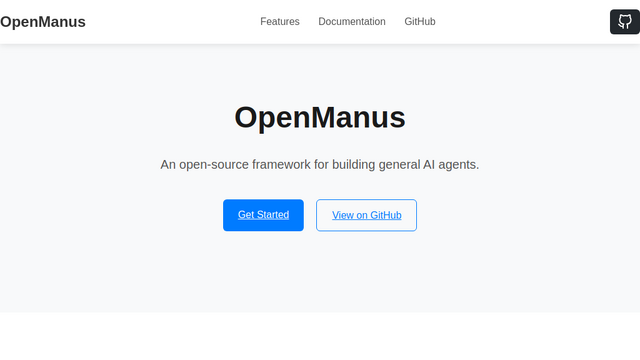
OpenManus is a powerful, open-source framework designed to simplify the development and deployment of general-purpose AI agents. Positioned as a community-driven alternative to proprietary agent platforms, it provides developers with a modular architecture to build agents capable of complex reasoning, tool usage, and autonomous task execution. By prioritizing flexibility and openness, OpenManus enables the creation of customized AI teammates that can interact with various APIs and external software environments.
Use Cases
Autonomous Web Research
Deploy agents to browse the internet, gather information from multiple sources, and synthesize comprehensive reports on specific topics.
Automated Coding Assistance
Build agents that can understand project contexts to write, debug, and refactor code across different programming languages.
Custom Workflow Automation
Develop specialized agents to handle repetitive administrative tasks such as data entry, scheduling, or cross-platform data synchronization.
Tool & API Orchestration
Create agents that act as intermediaries, connecting and controlling various SaaS tools and internal APIs through natural language.
AI Agent Prototyping
Provide a sandbox for researchers and developers to experiment with multi-agent systems and novel agentic reasoning patterns.
Features & Benefits
Modular Agent Framework
Offers a flexible core that allows developers to define unique agent behaviors, roles, and long-term memory capabilities.
Seamless Tool Integration
Includes a robust plugin system for easily connecting agents to external tools, web browsers, and third-party services.
Extensible Architecture
Designed to be model-agnostic, supporting integration with various LLM providers including OpenAI, Anthropic, and open-source models.
Autonomous Planning Engine
Equips agents with the ability to break down high-level goals into executable sub-tasks and adjust plans based on real-time feedback.
Open-Source Transparency
Fully community-driven development under a permissive license, ensuring no vendor lock-in and high security through public auditing.
High Customizability
Developers have full control over the agent’s logic and tools, unlike restrictive ‘black-box’ commercial alternatives.
Community-Led Innovation
Benefits from rapid updates and a growing ecosystem of community-contributed tools and agent templates.
Privacy & Sovereignty
Can be self-hosted, allowing organizations to maintain complete control over their data and API interactions.
Cons
Technical Complexity
Requires a strong background in programming and AI concepts to effectively build and deploy agents compared to no-code builders.
Documentation in Progress
As a relatively new open-source project, some advanced features may lack exhaustive documentation or require exploring the source code.