Omnigent | Open-Source Meta-Harness & Unified Control Plane for AI Agents
Omnigent
Introduction
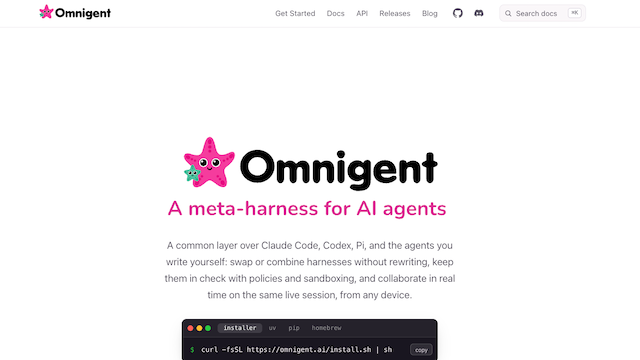
Omnigent is an open-source AI agent meta-harness and orchestration platform developed by researchers and engineers from Databricks. Sits one abstraction level above existing coding agents and agent harnesses (such as Claude Code, Codex, Cursor, Pi, and Hermes), Omnigent provides a unified runtime layer for composition, control, and real-time collaboration. Instead of locking teams into a single agent framework or fragile prompt-based safety rules, Omnigent standardizes session state across terminal, web, desktop, and mobile, while enforcing OS-level sandboxing, deterministic policy guardrails, and multi-model consensus.
Use Cases
Meta-Harness Composition & Model Switching
Swap or combine underlying execution harnesses (Claude Code, OpenAI Codex, custom YAML agents) with a one-line configuration without rewriting task logic.
Multi-Agent Review & Adversarial Debates
Deploy dual-agent workflows (like built-in Debby) to pit different foundation models (Claude vs. GPT-4o) against each other to review code diffs or converge on architectural proposals.
Air-Gapped & Ephemeral Cloud Sandboxing
Run untrusted agent commands safely in disposable container sandboxes (Modal, Daytona, E2B, CoreWeave, Kubernetes, Databricks) with network and filesystem isolation.
Deterministic Policy & Spend Governance
Enforce strict operational policies at the harness level (e.g., spend caps, blocking dangerous bash commands, mandating human approvals for sensitive file writes) outside the LLM prompt.
Cross-Device Session Continuity & Team Co-Driving
Start an agent session in your local terminal, monitor execution and review file diffs from a mobile app, and share live session URLs for teammates to co-steer in real time.
Features & Benefits
Universal Agent Runner & Session State Engine
Wraps diverse agent engines into a standardized, synchronized session state accessible via Terminal CLI, Web UI, Desktop apps, and iOS/Android.
Multi-Level Stackable Policies
Three-tier policy hierarchy (Server-wide, Agent-level, and Session-level) that enforces deterministic security guardrails and budget caps before tool execution.
OS-Level Sandboxing & Brokered Credentials
Isolates file system mutations and network calls while brokering API credentials so secret keys are never exposed directly to agent context windows.
Built-In Multi-AI Agents (Polly & Debby)
Ready-to-use reference agents for multi-model code orchestration and iterative multi-model consensus debates.
Declarative File-Backed Agents (YAML)
Define agent roles, allowed toolsets, system prompts, and operational boundaries using version-controllable YAML specifications.
Extensive Cloud Sandbox Integrations
Native connectors to provision on-demand managed host runners across Modal, E2B, Daytona, Kubernetes, and Docker environments.
Breaks Framework & Vendor Silos
Acts as an agnostic meta-layer, preventing vendor lock-in to any single agent harness (Claude Code, Cursor, or Codex).
Deterministic Security Outside Prompt Space
Enforces safety boundaries, spend budgets, and tool permissions at the runtime harness level rather than relying on prompt compliance.
Seamless Cross-Device Collaboration
True session portability across CLI, browser, and mobile enables background task execution with real-time human-in-the-loop steering.
Cons
Early-Stage Ecosystem Maturity
As an emerging open-source project, developer APIs and configuration schemas are undergoing active rapid development.
Sandbox Configuration Overhead
Enforcing full OS-level container isolation and network sandboxing in production requires setting up container runtimes or cloud sandbox providers (like E2B or Modal).