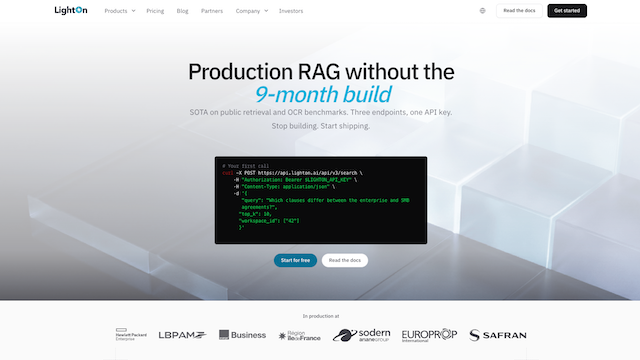
LightOn | Production RAG without the 9-month build
LightOn
Introduction
LightOn is a prominent European generative AI pioneer founded in Paris in 2016 and listed on Euronext Growth. Having pivoted from its early roots in optics-based hardware accelerators (Optical Processing Units), the company now specializes in secure, enterprise-grade software infrastructure for large-scale production AI. LightOn’s primary offering is Paradigm (integrated with LightOn Console), an all-in-one platform built for heavily regulated sectors like finance, public defense, healthcare, and telecommunications. It provides organizations with fully customizable RAG pipelines, advanced multi-vector retrieval architectures, and specialized document-understanding models that run seamlessly in localized, air-gapped, or private cloud environments.
Use Cases
Sovereign Public Sector AI Deployment
Deploy fully secure, local administrative assistants and data processing tools for government and municipality networks where citizen data cannot leave regional borders.
Enterprise RAG & Document Intelligence
Parse, index, and query thousands of dense internal files, technical schematics, or HR manuals without exposing intellectual property to public models.
High-Fidelity Visual OCR Processing
Utilize lightweight, vision-language models to extract structured layout data and dense text from complex scanned financial filings, invoices, and physical legal documents.
Multi-Vector Enterprise Code Search
Equip large-scale software engineering groups with advanced code retrieval models to surface and map clause dependencies across legacy codebases.
White-Label AI Infrastructure for Telcos
Provide telecom providers with pre-bundled, secure generative architectures to power private customer service routing and back-office agents.
Features & Benefits
Paradigm & Console Platforms
A unified business suite that combines model fine-tuning, workspace collaboration, and production orchestration layers under a single private dashboard.
LightOnOCR-2 (End-to-End Vision Model)
A lightweight, 1B-parameter Apache 2.0 open-source vision-language framework heavily optimized for localized, layout-aware OCR extraction and language adaptations.
Advanced Multi-Vector Search (FastPlaid & PyLate)
Proprietary open-source retrieval layers delivering massive performance boosts over traditional vector matching, built directly for dynamic RAG systems.
Air-Gapped & Private Cloud Flexibility
Engineered to bypass cloud-dependency risks by installing natively on-premise or within isolated corporate environments (supporting SOC 2, ISO 27001, and HIPAA compliance).
Real-Time Web-Grounding Hub
Maintains a strategic integration framework with live search web layers (e.g., Linkup partnership) to feed real-time internet data directly into secure enterprise workflows.
Model-Agnostic & MCP Bridging
Features out-of-the-box Model Context Protocol (MCP) servers, enabling terminal coding assistants and external agent systems to hook straight into private data layers safely.
Absolute Data Sovereignty
Guarantees that sensitive commercial, legal, or military records remain fully insulated from public cloud scraping or third-party training pipelines.
Highly Optimized Open-Source Tooling
Maintains a massive open contributions footprint via Hugging Face (e.g., ModernBERT collaboration and FastPlaid), providing verified performance upgrades for engineering teams.
Proven Public Market Compliance
As Europe’s first publicly listed GenAI startup, the company provides institutional-grade corporate compliance, risk tracking, and structured support agreements.
Cons
Significant Local Infrastructure Requirements
Deploying their enterprise suite within self-hosted, air-gapped topologies requires dedicated internal hardware planning and DevOps engineering overhead.
Over-Engineered for Early-Stage Solo Startups
The heavier emphasis on institutional risk frameworks, regional governance policies, and on-prem deployment metrics makes it overly restrictive for basic rapid prototyping.