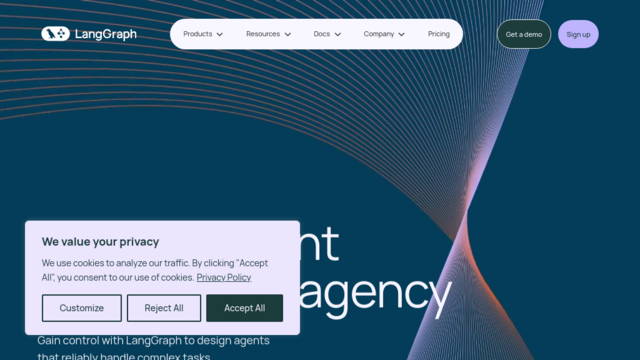
LangGraph | Build Custom Agents with Low-Level Control
LangGraph
Introduction
LangGraph is a library built on top of LangChain, designed to create stateful, multi-actor applications with LLMs by modeling computations as graphs. It enables more complex control flow, looping, and human-in-the-loop interactions, significantly extending LangChain’s capabilities beyond simple linear chains. By representing sequences of operations and states as nodes and edges, LangGraph facilitates the construction of highly interactive and intelligent agents.
Use Cases
Building complex agentic workflows
Design and manage sophisticated AI agents that require iterative decision-making, self-correction, and dynamic tool use.
Implementing human-in-the-loop systems
Integrate points for human feedback and intervention into LLM-powered applications, ensuring oversight and control.
Creating cyclical processes for reasoning
Develop applications that require looping or re-evaluation based on certain conditions, such as iterative refinement or search.
Developing multi-actor conversational AI
Orchestrate interactions between multiple LLM-powered agents to achieve a common goal or manage complex dialogues.
Enabling robust tool use with retry mechanisms
Build resilient systems where agents can retry tool calls, handle failures gracefully, and follow alternative paths upon errors.
Features & Benefits
Graph-based Representation
Offers a visual and intuitive way to model complex agent interactions and control flow, making design and debugging easier for multi-step processes.
State Management
Provides robust state management capabilities, allowing agents to remember previous interactions and update their state based on new inputs and actions.
Cyclical Execution
Supports loops and cycles within the graph, enabling sophisticated reasoning, self-correction, and iterative problem-solving in AI applications.
Human-in-the-Loop Integration
Facilitates the seamless inclusion of human oversight and intervention points, enhancing the reliability, safety, and performance of agentic systems.
Built on LangChain Ecosystem
Leverages the extensive ecosystem of LangChain, providing access to a wide range of LLMs, tools, retrieval mechanisms, and other LangChain components.
Enables complex agent design
Allows for much more sophisticated multi-step reasoning, dynamic decision-making, and advanced control flow than basic LangChain chains.
Strong state management
Crucial for building robust, conversational, and iterative AI applications that maintain context and evolve over time.
Visualizable workflows
The explicit graph structure aids significantly in understanding, debugging, and explaining complex logic flows, improving developer experience.
Extends LangChain’s power
Integrates seamlessly with existing LangChain components and concepts, providing an advanced layer for building stateful applications.
Cons
Increased complexity
Building graph-based applications can be more involved than simple chains, requiring a steeper learning curve for new users.
Debugging can be challenging
While visualizable, debugging complex state transitions, loops, and inter-agent communication can still be intricate.
Performance overhead
Managing state and complex graph executions might introduce some performance overhead compared to simpler, stateless LLM interactions.
Specific use cases
Primarily designed for advanced agentic workflows; it might be overkill for very simple, single-turn LLM interactions.