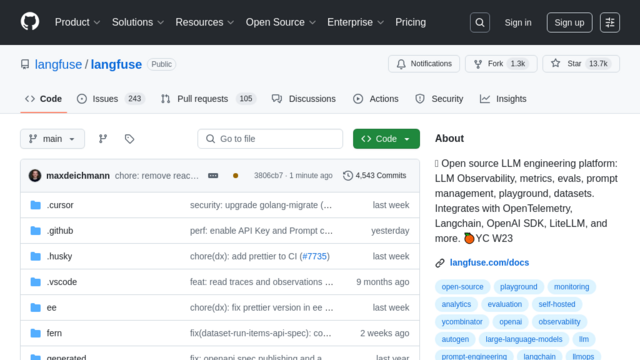
Langfuse is an open-source LLM engineering platform designed to help developers debug, evaluate, and iterate on their Large Language Model (LLM) applications. It provides comprehensive tools for observability, prompt management, and evaluations, enabling teams to build more robust and reliable AI-powered systems.
Use Cases
Debugging LLM Applications
Quickly identify and resolve issues in complex LLM chains by tracing every step of your application’s execution.
Evaluating Model Performance
Collect human feedback and integrate automated evaluations to measure and improve the performance of your LLM models over time.
Prompt Management & Versioning
Store, version, and deploy prompts efficiently, allowing for consistent prompt usage across environments and easy A/B testing.
Monitoring Costs & Latency
Track and analyze the costs and latency associated with your LLM API calls, helping to optimize resource usage and user experience.
Collaborative LLM Development
Facilitate teamwork in developing and fine-tuning LLM applications by providing a shared platform for insights and iteration.
Features & Benefits
Full Observability
Gain deep insights into your LLM application’s behavior with detailed trace visualizations, allowing for effective debugging and performance monitoring.
Prompt Management
Manage and version prompts directly within the platform, ensuring consistency and simplifying the process of updating and deploying new prompts.
Evaluations & Metrics
Integrate both human and automated evaluations to systematically track model performance, identify regressions, and drive continuous improvement.
User Sessions & Feedback
Group related traces into user sessions for contextual understanding and easily capture user feedback to inform future iterations.
Open Source & Self-Hostable
Leverage the flexibility of an open-source solution, offering the option to self-host for complete data control and customization to specific infrastructure needs.
Comprehensive LLM Observability
Provides excellent visibility into the workings of LLM applications, crucial for debugging and optimization.
Integrated Prompt Management
Simplifies the often complex task of managing, versioning, and deploying prompts, improving development efficiency.
Strong Evaluation Capabilities
Its focus on structured evaluation and feedback loops aids in systematically improving model quality.
Open Source & Flexible Deployment
The open-source nature offers transparency, community support, and the flexibility to self-host for data privacy and customizability.
Cons
Technical Setup Required for Self-Hosting
While flexible, self-hosting requires technical expertise and infrastructure management.
Learning Curve for Advanced Features
The depth of features might present a learning curve for users new to LLM observability and engineering platforms.
Dependency on LLM Ecosystem
As with any LLM-centric tool, its evolution is tied to the rapidly changing landscape of large language models and related technologies.