Is It Agent Ready | Scan your website to see if it’s ready for AI agents
Is It Agent Ready?
Introduction
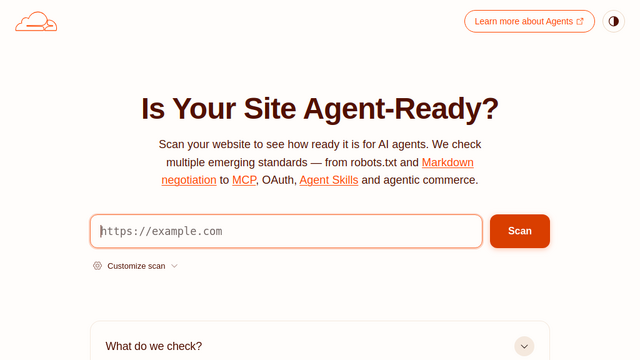
Is It Agent Ready? is a free, interactive web scanner launched by Cloudflare in April 2026. Functioning like ‘Lighthouse for the Agentic Web,’ the tool allows developers and webmasters to audit how legible, discoverable, and interactive their web infrastructure is for autonomous AI agents, multi-agent swarms, and RAG search crawlers. It scores websites from 0 to 100 based on a series of emerging 2026 technical protocols, identifying gaps and providing copy-pasteable code fixes to optimize websites for AI recommendations.
Use Cases
AI Search Visibility Optimization
Scan commercial web properties to ensure that AI search engines (like ChatGPT Search, Claude Search, and Perplexity) can seamlessly parse and cite your content in real-time answers.
Reducing LLM Scraping Overhead
Implement recommended Markdown content negotiation to decrease web-scraping payload sizes by 50% to 70%, drastically cutting down on server bandwidth and agent token consumption.
Agentic E-Commerce Enablement
Audit transactional platforms to ensure they possess the necessary protocol discovery layers for autonomous AI agents to execute purchases and checkouts safely.
CI/CD Agentic Diagnostics
Run the scanner programmatically via its native Model Context Protocol (MCP) server endpoint to continuously test staging websites for AI compatibility before production deployment.
Granular AI Data Policy Enforcement
Leverage the tool to verify that your data permissions—such as allowing real-time AI search indexing while blocking LLM model training—are correctly declared to crawlers.
Features & Benefits
Multi-Dimensional Scoring Matrix
Evaluates web properties across 5 core technical pillars: Discoverability, Content Accessibility, Bot Access Control, Protocol Discovery, and Agent Commerce.
Markdown Content Negotiation Check
Tests if the server appropriately honors the Accept: text/markdown request header, serving clean, token-efficient Markdown instead of heavily bloated HTML.
Content-Signal Framework Validation
Audits the site’s robots.txt file for modern configuration directives (e.g., ai-train=no, search=yes, ai-input=yes) to govern explicit usage policies.
Protocol Discovery Audit
Scans for advanced well-known AI integration paths, including the Model Context Protocol (MCP) server card, WebMCP hooks, Agent Skills indices, and OAuth protected metadata.
Actionable AI ‘Fix Recipes’
Every failed check dynamically provides an engineering blueprint or prompt designed to be fed straight into coding assistants (like Cursor or Claude Code) for rapid patching.
Native MCP Architecture
Exposed natively as an MCP server at /.well-known/mcp.json, enabling coding agents to run scans and parse results autonomously.
Establishes Clear Standards
Brings concrete structure to a fast-moving web paradigm, replacing vague ‘vibe coding’ adjustments with rigid, measurable technical benchmarks.
Drastic Performance Gains
Websites optimized according to the scanner’s checklist show up to a 5x drop in parse payloads and a 66% faster processing speed from browsing agents.
100% Free & Developer-Focused
Requires no paid subscriptions or registration, providing instant programmatic utility for teams building next-generation web platforms.
Cons
Standards Churn Risk
Many of the protocols checked (like Content-Signals or WebMCP) are active 2026 drafts, meaning site configurations may require frequent iteration as standards mature.
Policy vs. Technical Complexity
Several checks require high-level business decisions regarding data rights (such as AI model training permissions) rather than purely automated technical fixes.