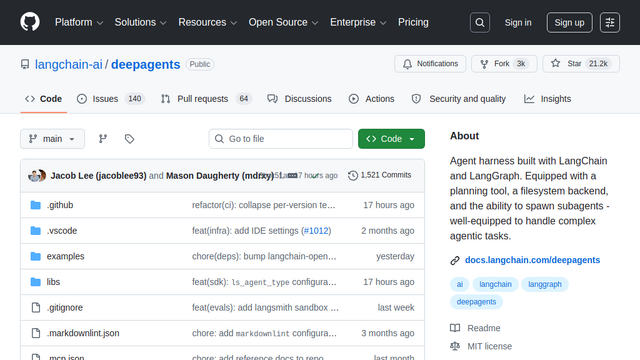
Deep Agents is an open-source, high-level agent harness built on top of LangGraph and the LangChain ecosystem. Released in early 2026, it is specifically designed to move beyond simple tool-calling loops and handle long-horizon, non-deterministic tasks. By implementing a ‘Planning First’ architecture, Deep Agents forces the AI to decompose complex goals into a structured TODO list before execution. It features a unique virtual filesystem for offloading massive context and the ability to spawn isolated subagents for specialized parallel work, making it the premier choice for autonomous software engineering and deep research.
Use Cases
Autonomous Software Engineering
Direct an agent to refactor a legacy codebase; it will scan the directory, create a multi-step migration plan, and spawn subagents to rewrite individual modules in parallel.
Deep-Horizon Scientific Research
Synthesize hundreds of research papers by offloading findings into a virtual filesystem, preventing context window collapse while maintaining a ‘global’ understanding of the topic.
Automated System Administration & DevOps
Use the ‘Sandbox Backend’ to safely execute shell commands, run tests, and manage cloud infrastructure across isolated environments like Modal or Daytona.
Interactive Coding Copilot (CLI)
Utilize the deepagents-cli to turn any terminal into an agentic workstation with persistent memory, session recovery, and built-in model switching.
Long-Running Data Extraction Pipelines
Build agents that monitor real-time feeds (e.g., financial markets or social sentiment) and autonomously update long-term knowledge graphs in the background.
Features & Benefits
Hierarchical Task Decomposition
Equipped with a native write_todos tool that ensures the agent follows a strategic roadmap rather than reactive tool usage.
Virtual Filesystem Backends
A pluggable storage layer (In-memory, Local Disk, or Sandbox) that allows agents to ‘write down’ large amounts of data to preserve context window space.
Context Offloading & Auto-Summarization
Automatically moves older conversation history or large tool outputs into storage, replacing them with searchable pointers as the context window exceeds 85% capacity.
Isolated Subagent Spawning
Enables the main ‘Orchestrator’ agent to delegate sub-tasks to fresh agent instances, ensuring context hygiene and allowing for parallel execution of complex jobs.
Model-Specific Performance Profiles
Includes optimized prompt templates and tool definitions tailored specifically for Gemini 3.1, GPT-5.4, and Claude 4.7 to maximize reasoning accuracy.
Durable Execution with LangGraph
Inherits LangGraph’s state management, allowing tasks to pause for human approval and resume across process restarts or deployments.
Solves ‘Context Bloat’
The filesystem approach allows agents to work on tasks that would typically crash a standard LLM’s context window through excessive tool logs.
Extreme Flexibility
Unlike rigid SaaS agents, Deep Agents is model-agnostic and supports any provider from OpenAI and Anthropic to local models via Ollama.
Production-Ready Traceability
Natively integrates with LangSmith for debugging agent trajectories, enabling developers to see exactly how a plan evolved or where it failed.
Cons
Steeper Learning Curve
Requires an understanding of the LangChain/LangGraph stack; users looking for a ‘no-code’ experience may find the SDK configuration complex.
Resource Overhead
Spawning multiple subagents and managing a virtual filesystem can lead to higher token costs and compute requirements compared to simpler chains.