DataLab | Open-source signal and image processing platform
Datalab
Introduction
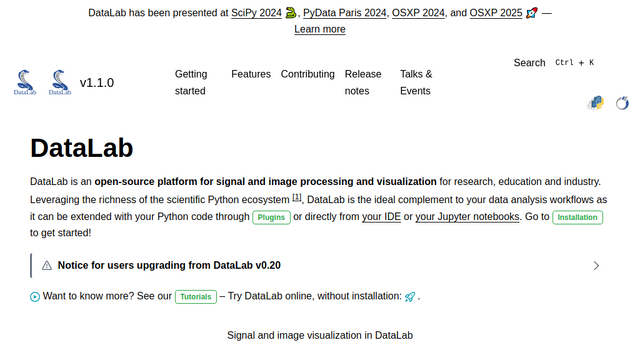
DataLab is a high-performance, open-source platform designed for visual signal and image processing in research, education, and industry. Built on the scientific Python ecosystem (NumPy, SciPy, scikit-image, OpenCV), it provides a graphical user interface (GUI) for complex data analysis without requiring extensive coding. It serves as a visual alternative or complement to Jupyter notebooks, allowing users to perform advanced processing through a dedicated desktop application while remaining fully extensible via Python plugins and IDE integrations.
Use Cases
Industrial Quality Control
Analyze high-resolution images and signals from production lines to detect anomalies, measure dimensions, and verify structural integrity in real-time.
Scientific Research & Data Visualization
Process experimental data from sensors (spectroscopy, seismology) or imaging devices (microscopy, medical imaging) with built-in filters and transformation tools.
Academic Education
Teach signal and image processing concepts using a visual, interactive interface that helps students understand the impact of various algorithms (FFT, Wavelets, Morphological filters).
Rapid Prototyping for Data Science
Quickly test different processing pipelines on localized datasets before scaling them into production Python scripts or automated workflows.
Legacy System Modernization
Replace old, proprietary signal analysis software with a modern, open-source stack that can be easily customized and maintained by in-house Python developers.
Features & Benefits
PlotPyStack Visualization Engine
Utilizes a powerful Python-Qt stack to provide high-performance, interactive 1D and 2D plots that can handle large datasets with low latency.
Sigima Processing Library
An integrated open-source library that provides the core primitives for advanced signal and image manipulation, including filtering, denoising, and feature extraction.
Plugin-Based Architecture
Allows developers to easily add custom processing steps or new data formats using standard Python code, making the platform highly extensible.
Jupyter & IDE Connectivity
Can be controlled directly from external Python environments, enabling a hybrid workflow where code and GUI visualization work together.
Comprehensive Algorithm Suite
Built-in support for Fast Fourier Transforms (FFT), wavelet analysis, edge detection, image registration, and morphological operations.
100% Free & Open Source
Funded by organizations like CEA (French Atomic Energy Commission) and NLnet, ensuring long-term sustainability without licensing fees.
Reduced Coding Barrier
Provides a professional-grade analysis environment for domain experts (physicists, biologists, engineers) who may not be proficient in Python.
Modular Design
The clear separation between the UI and the processing core (Sigima) allows parts of the platform to be reused in other standalone applications.
Cons
Niche Scientific Focus
Primarily optimized for 1D/2D signal and image data; it is not intended for general-purpose business intelligence or Big Data analytics.
Desktop-First Environment
While an online ‘binder’ version exists for testing, the platform is primarily designed as a local desktop application, which may not fit cloud-only workflows.