Bardeen | The AI Work Intelligence & Browser Automation Platform
Bardeen
Introduction
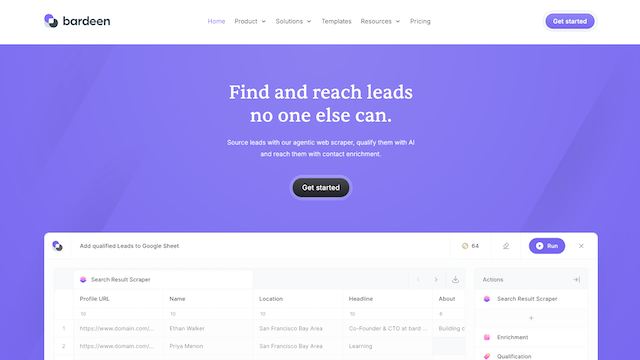
Bardeen is a leading AI-powered workflow automation and web scraping platform that runs directly inside your web browser. Built primarily for Go-To-Market (GTM) teams, recruiters, and ops managers, Bardeen bridges the gap between traditional point-and-click scraping extensions and complex cloud iPaaS setups. Rather than forcing users to manually map selectors or write custom scripts, its Work Intelligence Core enables builders to describe desired automation outcomes in plain natural language. Bardeen then programmatically generates, trains, and executes client-side ‘Playbooks’ to extract data, enrich leads, and sync records across over 100+ popular SaaS applications.
Use Cases
AI-Driven Lead Sourcing & Scraping
Extract highly structured lists of prospects, job descriptions, or real estate listings directly from active browser pages (such as LinkedIn, Apollo, or Yelp) and pipe them cleanly into spreadsheets without writing code.
Sub-Second B2B Contact Enrichment
Instantly fill in missing phone numbers, verified professional emails, current job titles, and active company sizes for arbitrary web profiles via native multi-provider data validation pools.
Natural Language Workflow Scaffolding
Automate manual back-office tasks by typing direct prompts like ‘When I star an email, find their LinkedIn profile and log them to HubSpot,’ allowing the AI agent to map the underlying steps.
Automated Competitor & Price Monitoring
Deploy scheduled background scrapers that track competitor web changes, e-commerce listings, and product drops, sending structural update briefs directly to Slack or Notion.
Inbound Lead Fit Scoring & Prioritization
Evaluate newly scraped or inbound lead batches against strict Ideal Customer Profile (ICP) parameters to automatically tag, rank, and route high-value targets to sales development reps (SDRs).
Features & Benefits
Context-Aware Natural Language Playbook Builder
Translates standard text-based requests directly into multi-step automation sequences, bypassing complex trigger/action configuration screens.
Client-Side Browser Execution Engine
Operates straight within a local Chrome/Edge extension layer, giving the automation framework the ability to read and scrape structural web elements that API-restricted backend bots cannot access.
100+ Pre-Certified App Integrations
Maintains native, bidirectional connection pathways supporting immediate synchronization across core tools like Google Sheets, Airtable, Notion, HubSpot, Salesforce, and Slack.
Comprehensive Outbound Playbook Template Library
Provides over 1,000+ pre-built, community-verified automation recipes tailored for instantaneous activation across sales prospecting, recruitment, and market research.
Granular Credit-Metered Operations
Tracks performance metrics using a row-action credit scheme (1 credit for typical scraping rows, 3 credits for premium data enrichments), keeping file downloads and CSV exports free.
Enterprise Governance & Compliance Posture
Fully certified under strict operational security benchmarks, including SOC 2 Type II, GDPR, and CASA Tier 2/3 validation frameworks.
Unmatched Browser-Level Access
Can easily navigate, capture, and interact with web data hidden behind modern authorization screens or complex UI layouts that stymie traditional cloud scrapers.
Zero Coding Horizon Requirements
Bypasses technical programming roadblocks entirely, enabling non-technical operators to deploy automated workflows in minutes rather than engineering sprints.
Frictionless Local Execution Environment
Running primary workloads locally within the extension reduces infrastructure overhead and makes small-scale scraping projects highly cost-effective.
Cons
Vulnerable to Front-End Design Changes
Because browser-level scraping relies on the structural visual markup of target websites, unexpected UI updates on external platforms (like LinkedIn) can disrupt active playbooks.
Dependent on Active Browser States
Standard automations rely on your local browser instance staying active; off-screen background task handling requires transitioning to higher-tier cloud compute credits.