Autogen | A framework for creating multi-agent AI applications
AutoGen
Introduction
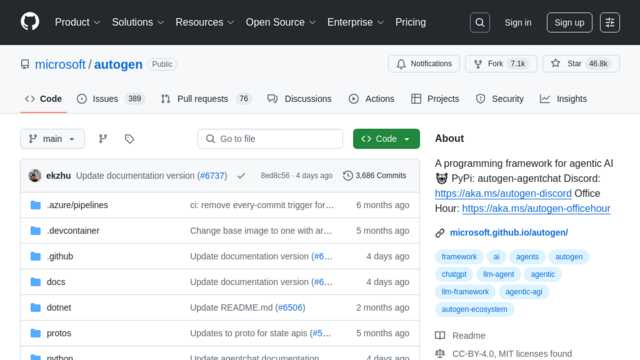
AutoGen is a powerful open-source framework developed by Microsoft that simplifies the orchestration of complex AI workflows by enabling multiple AI agents to converse with each other to collaboratively solve tasks. It provides a customizable and conversable system that supports various communication patterns and integrates seamlessly with large language models (LLMs), human input, and external tools.
Use Cases
Automated Code Generation and Debugging
Agents can collaboratively write, test, and debug code snippets, offering a powerful solution for software development and automation tasks.
Complex Problem Solving
It excels at decomposing large, intricate problems into smaller, manageable sub-tasks, assigning them to specialized agents for collaborative resolution.
Data Analysis and Reporting
An agent can analyze datasets, generate insights, and then pass these findings to another agent for structured report generation or data visualization.
Interactive Application Development
Building dynamic applications where AI agents interact with users and other agents to provide services, answer queries, or offer personalized assistance.
Research and Information Gathering
Agents can autonomously search for information, synthesize findings from multiple sources, and present summarized, coherent results on a given topic.
Features & Benefits
Multi-Agent Conversation Framework
Enables complex workflows where multiple AI agents can communicate and collaborate to achieve a common goal, mimicking human team dynamics and enhancing problem-solving capabilities.
Customizable and Conversable Agents
Allows users to define agents with specific roles, capabilities, and behaviors, making the framework highly adaptable to a wide range of applications and user requirements.
Tool Integration Capabilities
Supports the seamless integration of various tools (e.g., Python scripts, APIs) that agents can use to perform actions, extending their capabilities beyond pure LLM responses.
Human-in-the-Loop Functionality
Facilitates human supervision and intervention in the agent conversation flow, ensuring control, fine-tuning, and alignment with human intent where needed.
Diverse Application Support
Designed to support a broad spectrum of LLM applications, including code generation, question answering, reasoning, task automation, and more, offering significant flexibility for developers.
High Flexibility and Customization
Offers extensive options to define and configure agents, workflows, and communication patterns, making it adaptable to diverse use cases.
Powerful for Complex Tasks
Excellently suited for breaking down and solving multi-step, complex problems through sophisticated agent collaboration.
Strong Community Support
Backed by Microsoft and an active open-source community, ensuring ongoing development, ample resources, and quick issue resolution.
Seamless Human-AI Collaboration
Integrates human input effortlessly, allowing for guided and controlled AI operations and enhancing the reliability of outcomes.
Cons
Steep Learning Curve
Can be challenging for beginners due to its advanced concepts and extensive configurability, requiring significant time to master.
Resource Intensive
Running complex multi-agent systems, especially with powerful LLMs, can require significant computational resources, leading to higher operational costs.
Debugging Complexity
Debugging and tracing issues in multi-agent conversations can be more complex and time-consuming than in simpler, single-agent systems.
Dependency on LLM Quality
The overall effectiveness and performance of the agents heavily rely on the quality, capabilities, and consistency of the underlying Large Language Models used.