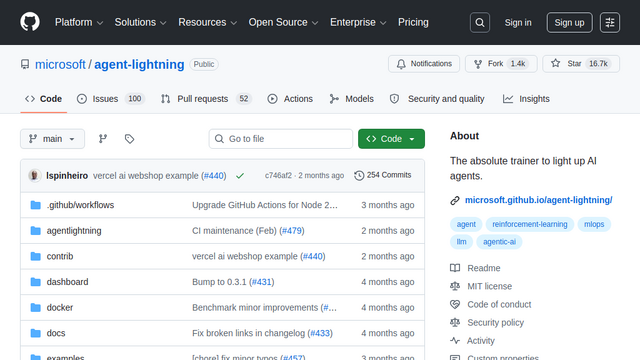
Agent Lightning | One learning system that makes all agents evolve
Agent-Lightning
Introduction
Agent Lightning is an open-source optimization framework from Microsoft Research (MSR) designed to turn any AI agent into an adaptive, learning-based system. Unlike static agent frameworks, Agent Lightning treats ‘learning from experience’ as a first-class capability. By leveraging reinforcement learning (RL) and automated prompt tuning, it allows agents to improve their task success rates over time without requiring significant code changes. It decouples the ‘agent logic’ from the ‘learning logic,’ making it compatible with any existing framework like LangChain, AutoGen, or CrewAI.
Use Cases
Production Performance Optimization
Train a lightweight (1.5-bit) model to achieve GPT-4 level performance in specialized tasks like text-to-SQL or RAG through iterative reinforcement learning.
Automated Prompt Tuning (APO)
Improve agent success rates in complex software engineering tasks—such as formal verification in Rust—at a fraction of the cost of manual prompt engineering.
Multi-Agent Coordination Learning
Optimize how different agents (Analyst, Coder, Reviewer) interact, doubling task success rates in multimodal robotic and customer service environments.
Continuous Deployment Learning
Capture real-world interaction data from production and use it as a ‘feedback loop’ to refine agent behavior against edge cases that static testing misses.
Zero-Code-Change RL Integration
Retrofit existing agents built on virtually any Python-based stack with ‘experiential memory’ to solve the ‘long sequence problem’ in multi-turn dialogues.
Features & Benefits
Non-Intrusive Tracing (Sidecar Design)
Uses a sidecar-based monitoring system (built on OpenTelemetry) to ‘spy’ on agent execution, recording traces and rewards without interfering with original code.
Unified LightningStore Hub
A central data repository that synchronizes tasks, execution traces (spans), and updated resources like refined prompt templates or model weights.
Decoupled Infrastructure
Separates the ‘Agent Runner’ (CPU-based execution) from the ‘Algorithm’ (GPU-based training), allowing both components to scale independently.
Advanced RL Algorithm (EMPO2)
The first RL algorithm capable of training agents with persistent memory, significantly improving exploration in new, out-of-distribution environments.
Hierarchical Reinforcement Learning
Breaks down complex, long-horizon tasks into manageable sub-steps, allowing standard algorithms like PPO or GRPO to handle multi-turn agent interactions.
Extreme Framework Compatibility
Works with LangChain, AutoGen, OpenAI SDK, and custom frameworks with ‘almost zero’ code changes—often just an `@rollout` decorator.
Massive Scaling Potential
Community-verified support for up to 128-GPU RL training with steady convergence on math and coding benchmarks (e.g., Youtu-Agent).
Measurable ROI for Enterprises
Moves agents from ‘vibe-based’ prompt engineering to a compounding intelligence layer that can be measured and audited through success metrics.
Cons
Reward Function Complexity
Effective optimization requires carefully designed reward functions; poorly defined metrics can lead to agents ‘gaming the system’ or maximizing wrong behaviors.
RL Training Instability
As with all reinforcement learning systems, training can be unstable, especially in complex multi-agent environments with sparse rewards.