Loop Engineering | Practical Patterns, Starter Kits & CLI Tools for AI Agent Loops
Loop Engineering
Introduction
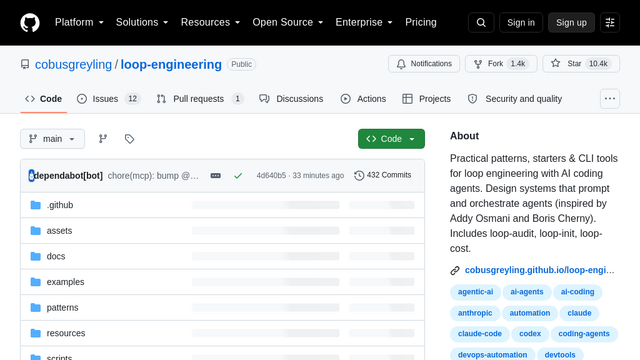
Loop Engineering is an open-source pattern library, architecture guide, and CLI toolkit designed to operationalize autonomous AI coding agents (such as Claude Code, Grok Build, Codex CLI, OpenClaw, and GitHub Actions). Rooted in the paradigm that developers should transition from manually typing iterative prompts to designing deterministic systems that prompt, verify, and govern agents, this framework provides battle-tested blueprints for managing state, preventing runaway token costs, and safely escalating autonomy from report-only runs (L1) to fully unattended execution (L3).
Use Cases
Daily Issue & Codebase Triage
Deploy scheduled or event-driven agent loops that scan repositories for new issues, evaluate reproduce steps, verify fixes in isolated git worktrees, and generate pull request drafts.
Automated Refactoring & Technical Debt Burndown
Break large codebase modernization initiatives into micro-tasks managed through a persistent `STATE.md`, having maker agents patch code and checker agents run test suites.
PR Babysitter & CI Maintenance
Run thin GitHub Action loops that automatically address review feedback, rebase branches, and resolve trivial test failures without human context-switching.
Cost & Runaway Token Prevention
Audit and simulate loop budgets prior to execution using CLI tooling to prevent recursive prompt loops and uncontrolled API spend.
Progressive Autonomy Rollout (L1 to L3)
Transition engineering workflows gradually from report-only advisory outputs (L1) and human-assisted staging (L2) to trusted, policy-bounded unattended automation (L3).
Features & Benefits
Unified Front Door CLI (`@cobusgreyling/loop`)
Command-line interface featuring `init`, `doctor`, `status`, `audit`, and `cost` to scaffold pattern templates and assess repository readiness.
The Five Core Primitives + External Memory
Standardizes loops across six architectural components: Schedulers (cron/triggers), Git Worktrees (collision isolation), Skills/Tool specifications, Connectors (MCP), Sub-agents (Maker/Checker split), and Durable State (`STATE.md`).
Loop Readiness Scoring (`loop-audit`)
Evaluates repository hygiene, verification harnesses, and guardrail constraints, outputting an actionable readiness score for CI checks.
Cross-Agent Harness Compatibility
Supports major coding agent environments interchangeably—including Claude Code, Codex, Grok, OpenClaw, and standard shell automation.
Pre-Engineered Pattern Catalog
Ready-to-use production blueprints including Daily Triage, Changelog Drafter, Dependency Updater, Refactor Pipeline, and Post-Merge Cleanup.
Durable Memory Outside Model Context
Decouples state from volatile token windows by persisting run histories, task dependencies, and error logs into filesystem-backed Markdown/JSON states.
Transforms Manual Prompting into Predictable Systems
Shifts developer effort from repetitive conversational steering to designing robust feedback loops and deterministic evaluation gates.
Model and Tool Agnostic
Provides a unified conceptual and procedural layer that works seamlessly whether teams rely on Anthropic’s Claude Code, OpenAI Codex, or local agent runners.
Strong Focus on Safety & Budget Governance
Built-in cost estimation tools, anti-pattern catalogs, and progressive autonomy tiers prevent catastrophic token burn or bad unattended code commits.
Cons
Requires Rigorous Automated Test Suites
Loop engineering relies fundamentally on deterministic verification; codebases with poor test coverage or flaky CI cannot effectively steer autonomous agents.
Organizational Process Paradigm Shift
Adopting unattended agent loops requires developers to learn state management, task-boundary definition, and prompt audit mechanics rather than treating LLMs as standard chat assistants.