Pinchy | Self-Hosted, Role-Bounded & Fully Audited Team AI Agent Workspace
Pinchy
Introduction
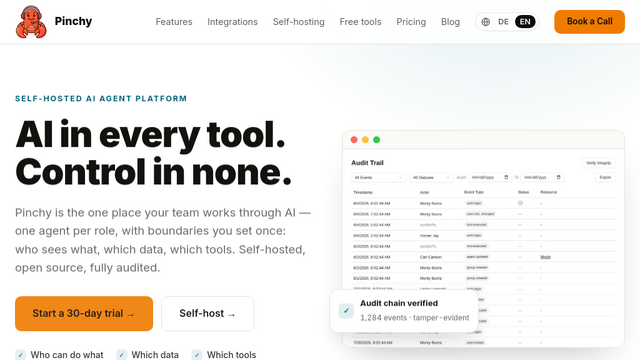
Pinchy is an open-source, self-hosted AI agent platform built for teams that work through AI with strict governance. Instead of exposing company data to unmonitored external LLM accounts or building brittle manual automations, Pinchy organizes AI usage into role-based agents (one agent per role). Administrators configure strict operational boundaries once—governing who sees what, which internal datasets can be accessed, and which external tools can be triggered—backed by complete, tamper-evident audit trails and full infrastructure sovereignty.
Use Cases
Role-Bounded Team AI Workspace
Deploy dedicated AI agents tailored to specific departments or operational roles (e.g., Finance, Support, Engineering, HR) with isolated knowledge domains and permissions.
Strict Tool & Data Governance
Prevent unauthorized actions and sensitive data leakage by enforcing boundaries on which tools an agent can execute and which documents it can inspect.
Regulated & Air-Gapped Enterprise AI
Self-host the entire agent orchestration stack within internal private clouds or on-premise infrastructure, satisfying strict corporate compliance and data residency requirements.
Tamper-Evident Operational Auditing
Maintain comprehensive, immutable logs of every prompt turn, agent reasoning step, internal data retrieval, and external tool call for security reviews and compliance audits.
Consolidated Team AI Gateway
Provide a unified internal hub where employees interact with company-approved agents instead of scattering sensitive corporate data across disparate public AI tools.
Features & Benefits
One Agent Per Role Architecture
Configures specialized AI agents mapped directly to organizational roles, each initialized with unique system prompts, responsibilities, and behavioral constraints.
Granular Boundary & Permission Controls
Centralized administration to specify exact tool permissions, data access scopes, and user visibility rules per agent.
100% Self-Hosted & Open-Source Core
Deployable on your own servers or private VPC, ensuring complete data ownership with zero telemetry or customer data leaking to third-party hosts.
Full Audit Logging & Traceability
Records detailed audit trails of user inputs, agent decisions, tool execution payloads, and outputs to ensure complete accountability.
Tool & Integration Whitelisting
Default-deny security model that restricts agents to explicitly approved APIs, database connectors, and internal services.
Multi-LLM & Local Model Support
Flexibility to connect commercial frontier model APIs or completely offline, self-hosted local model backends (such as Ollama or vLLM).
Total Data Sovereignty & Security
Self-hosting and strict boundary controls eliminate the data privacy risks inherent in multi-tenant SaaS AI workspaces.
Clear Team Accountability
Role-based agents and end-to-end audit logs make it clear who triggered an agent, what data was accessed, and what actions were performed.
Prevents Autonomous Agent Runaways
Explicit ‘set-once’ boundaries for tools and data access prevent agents from executing unexpected or destructive commands.
Cons
Self-Hosting Infrastructure Overhead
Requires internal engineering or DevOps resources to provision, update, and manage the hosting environment and database backends.
Upfront Configuration Required
Setting up distinct roles, access rules, and tool integrations takes planning compared to instantly signing up for a consumer SaaS chat tool.