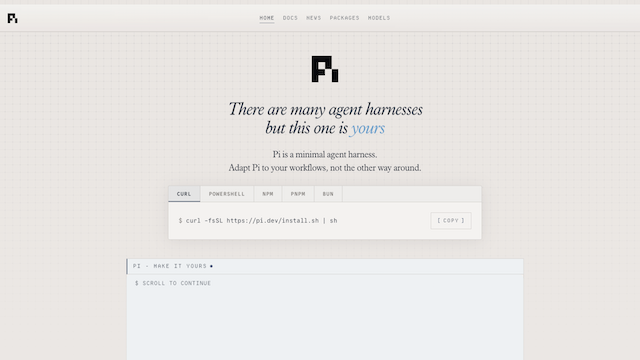
Pi.dev is an open-source (MIT) terminal-native coding harness engineered by Earendil Inc. Built on the core principle of ‘adapt Pi to your workflows, not the other way around,’ it deliberately strips out the heavy, opinionated abstractions of typical AI agents (like built-in sub-agents, plan modes, or permission popups). Instead, it loads a tiny default system prompt and standard tool primitives, shifting the complexity of custom behaviors, agent orchestration, and interface design entirely into portable, user-driven TypeScript extensions, skills, markdown templates, and packages distributed natively via npm or git.
Use Cases
Highly Auditable Local Development
Keep code modifications, shell commands, and raw inputs inside an easily auditable local terminal loop, protecting flow states and preventing remote tracking.
Dynamic Workflow Tailoring via Self-Modification
Instruct Pi to code a missing capability or TUI widget for itself, hit /reload, and instantly use the newly generated extension within the active terminal session.
Seamless Mid-Session Model Hot-Swapping
Swap underlying LLM reasoning engines mid-stream using /model or hotkeys, calling fast models for text parsing and shifting to premier models for deep structural refactoring.
Granular Project Context Engineering
Isolate per-project guidelines and control token overhead using localized instruction templates (AGENTS.md / SYSTEM.md) that append directly into the prompt cache.
Durable Non-Interactive Script Ingestion
Drive agent execution cleanly inside headless automated data pipelines or local background cron networks using native print, JSON stream, or standard RPC modes.
Features & Benefits
7-Tool Core Primitive Suite
Ships with an intentional, razor-thin out-of-the-box tool library limited strictly to: read, write, edit, bash, grep, find, and ls.
15+ Multi-Provider Ecosystem Integration
Supports native connections across hundreds of models via API keys or subscription OAuth channels (including Anthropic, OpenAI, Gemini, Bedrock, Groq, and local Ollama nodes).
Tree-Structured Branching History
Stores conversation histories as nonlinear branch structures within a single JSONL file, allowing developers to fork side-quests to fix broken tools via /tree without polluting main branches.
Eliminates the Recurring Prompt Token Tax
Ditching heavy 10,000+ token corporate system prompts leaves your entire context window and API budget free for the task at hand.
Total Infrastructure Customization Control
Provides absolute, unfiltered authority over the harness, letting developers assemble exactly the security gates, SSH sandboxes, or prompt rules their workflow demands.
Server-Shaped From Day One
Treating JSONL, RPC, and programmatic SDK integration endpoints as core primitives makes embedding Pi into external services or apps remarkably clean.
Cons
Requires Active Engineering Investment
Because it strictly skips pre-built abstractions, developers must be willing to leverage TypeScript extensions or write custom skills to achieve complex autonomous behaviors.
High Keyboard Hotkey Familiarity Hurdle
Navigating tool collapse menus, thinking block expansions, and deep session branching relies heavily on mastering terminal TUI key chords.