Otio | Your AI Research Assistant & Multi-Model Writing Workspace
Otio
Introduction
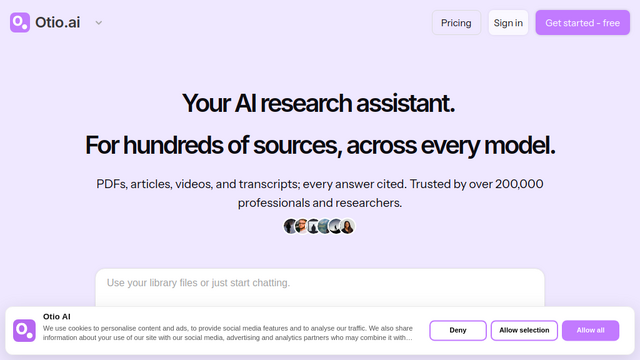
Otio is an advanced AI-native research repository and writing platform designed to combat context fragmentation and session memory limits. Serving as a continuous, intelligent workspace for over 200,000 professionals, academics, and creators, Otio allows users to effortlessly collect hundreds of diverse source materials—including PDFs, deep academic papers, lengthy YouTube videos, podcasts, and articles—into permanent project libraries. By providing unified, cross-document semantic synthesis, fully traceable page/passage citations, and an integrated AI text editor, Otio turns unstructured reading backlogs into organized, ready-to-write knowledge bases.
Use Cases
Long-Horizon Academic Literature Reviews
Upload 50+ dense research papers to simultaneously extract, cross-reference, and compare methodologies or key findings without losing context to model chat session limits.
B2B Discovery & Corporate File Auditing
Consolidate massive piles of unstructured client briefs, multi-hour meeting transcripts, and market reports to quickly map overarching business themes and hidden insights.
Legal Discovery Analysis & Document Contradiction Checks
Incorporate extensive case files, depositions, and regulatory compliance documents to isolate explicit factual timelines or internal logical contradictions with absolute precision.
Multi-Format Content & Media Research Aggregation
Streamline research workflows for creators and journalists by pooling YouTube videos, long-form essays, podcasts, and tweets directly into thematic briefs.
Persistent Personal Knowledge Engine Building
Build a cumulative, organized company or personal knowledge vault across multiple months, avoiding the standard context clearing thresholds typical of vanilla LLM chats.
Features & Benefits
Un-Capped Multi-Source Persistent Libraries
Bypasses traditional context limits and notebook caps, allowing users to aggregate hundreds of documents over months while maintaining global searchability.
Unified Multi-Model Gateway Access
Provides direct workspace orchestration across elite foundational model families, including the Claude 4.5, GPT-5.1, Grok 4, and Gemini 2.5 ecosystems.
Strict Dynamic Passage & Page Citation Matching
Anchors every AI summary, synthesis, or answer back to a traceable, one-click snippet linked explicitly to the original source location.
Thematic Argument Grouping Engine
Re-arranges extracted research data on the fly, clustering distinct information arrays dynamically by overarching theme rather than sorting strictly by individual document source.
Integrated Collaborative AI Text Editor
Combines a powerful long-form markdown editor directly with the retrieval pane, enabling users to transform background research into outlines and drafts side-by-side.
Omnipresent Web Capture Chrome Extension
Features a highly fluid, one-click browser utility to snapshot web pages, scrape video timelines, index sub-stacks, and open cross-library spotlight searches using shortcuts.
Eliminates AI Session Resets
Unlike standard commercial chat rooms that completely suffer from chat amnesia once a single multi-turn session ends, Otio serves as an enduring context graph.
Cross-Format Media Ingestion Adaptability
Saves researchers thousands of manual reading hours by converting long-form video audio layers and heavy PDF texts into matching semantic blocks instantly.
Seamless Side-by-Side Drafting Flow
Reduces cognitive friction by uniting the exploratory chat layout, original source citations, and production writing window inside a single viewport canvas.
Cons
Relies Heavily on Source Extraction Fidelity
The precision of thematic summaries and downstream synthesis depends directly on the text or transcription clarity of the ingested media files.
Requires Strict Initial Project Separation
Power users must actively allocate documents to distinct workspace buckets to keep distinct research domains from cross-pollinating query contexts.
Higher Initial Source Ingestion Latency
Processing dozens of dense academic files or parsing hours of raw video audio requires upfront processing steps before full interactive querying activates.