FalkorDB | The Low-Latency Graph Database Purpose-Built for AI Agents & GraphRAG
FalkorDB
Introduction
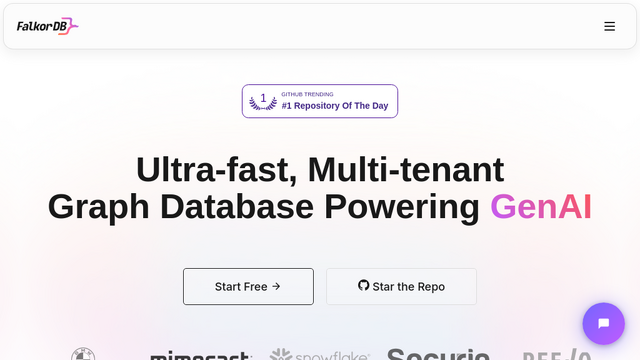
FalkorDB is a high-performance, in-memory graph database specifically engineered to serve as the core memory and knowledge layer for GenAI applications. Re-architected as an LLM-oriented data platform, FalkorDB excels at curing ‘AI amnesia’ and powering GraphRAG (Retrieval-Augmented Generation) pipelines. By representing interconnected datasets as sparse adjacency matrices and using vectorized linear algebra (GraphBLAS-style operations) for rapid traversal, it provides a fast, low-latency, and memory-efficient alternative to traditional pointer-chasing graph databases.
Use Cases
High-Speed GraphRAG Pipelines
Combine relationship traversal with built-in vector similarity search to feed LLMs with dense, domain-specific contextual knowledge graphs while mitigating hallucinations.
Persistent Agentic Memory Banks
Equip autonomous AI agent swarms with a centralized, multi-tenant memory workspace that logs past decisions, user states, and conversation contexts in real time.
Real-Time Personalization & Recommendation Engines
Map vast user profiles, explicit behavior traits, and historical action graphs to deliver sub-millisecond, contextual recommendations mid-turn.
Fraud Investigation & Forensic Asset Audits
Store financial transactions, device markers, and transfer hops in a flexible schemaless format to surfaces hidden circular patterns and anomalies instantly.
Cybersecurity Threat Intelligence
Ingest multi-layered system assets, known vulnerabilities, and access permissions into an active Security Graph to detect and trace network threats.
Features & Benefits
Sparse Matrix Matrix-Based Execution
Swaps out traditional pointer-chasing traversal for vectorized linear algebra calculations, achieving up to 490x faster performance than traditional graph platforms under heavy loads.
Native GraphRAG & AI Agent SDKs
Bundles specialized open-source development frameworks (including the GraphRAG-SDK and ActiveGraph) to streamline connecting graph indices directly into LLM apps.
Built-In HNSW Vector Similarity Search
Blends deep graph structural lookups and semantic vector similarity matches into a single, unified openCypher query flow.
Redis-Native In-Memory Architecture
Leverages Redis’s high-throughput memory engine for state management, data caching, and instant point lookups while utilizing standard Append-Only File (AOF) snapshotting for persistence.
Multi-Tenant Schema Isolation
Supports running large numbers of independent, isolated graphs on a single instance, making it perfect for managing distinct tenant databases or individual user-agent profiles.
Advanced IDE & Visualization via gdotv
Integrates with a dedicated developer environment featuring automated schema-inferred visualizations, real-time Cypher code auto-completion, and one-click query profiling.
Blistering Latency Performance
Boasts industry-leading read speeds, logging a p50 latency of around 36ms compared to much higher tail latencies in disk-backed graph structures.
Extreme Memory Efficiency
Vectorized graph layouts reduce indexing overhead significantly, consuming up to 6x less RAM than heavy JVM-based alternatives handling identical node sets.
Expressive openCypher Compatibility
Allows developers to write clean, standard declarative graph queries with built-in extensions for vector matching, minimizing developer friction.
Cons
RAM-Bound Storage Caps
Because the entire operational graph runtime is kept in-memory to sustain low latencies, scaling to massive multi-terabyte datasets requires careful horizontal allocation.
Strict Single-Threaded Coordination Core
Relying on Redis’s single-threaded core coordination layer means concurrent write throughput peaks around specific thread ceilings.