vLLM | Easy, fast, and cost-efficient LLM serving for everyone
vLLM
Introduction
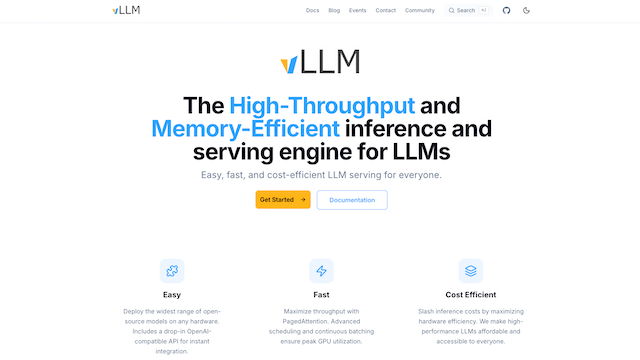
vLLM is a high-throughput and memory-efficient open-source library for LLM inference and serving. By leveraging PagedAttention, it achieves state-of-the-art performance in memory management and request throughput, making it a standard choice for deploying large-scale models in production environments.
Use Cases
Scalable API Serving
Building and maintaining a high-performance backend for LLM-powered applications that require low latency.
Private Enterprise RAG
Powering Retrieval-Augmented Generation systems within secure, self-hosted environments to maintain data privacy.
Batch Data Processing
Running large-scale text analysis or transformation tasks across massive datasets using open-source models.
Cloud Infrastructure Optimization
Reducing the operational costs of GPU clusters by maximizing the requests handled per hardware unit.
LLM Research and Development
Prototyping and testing new model architectures and quantization methods in a high-performance setting.
Features & Benefits
PagedAttention
An innovative attention mechanism that manages KV cache memory effectively, reducing fragmentation and waste.
Continuous Batching
Dynamic request scheduling that maximizes GPU utilization by starting new requests before previous ones finish.
Tensor Parallelism Support
Enables the serving of extremely large models by distributing the workload across multiple GPUs efficiently.
OpenAI-Compatible API
Provides a drop-in replacement for the OpenAI API, simplifying the migration from proprietary to open-source models.
Decoding Optimization
Includes high-performance CUDA kernels and supports various decoding strategies like beam search and sampling.