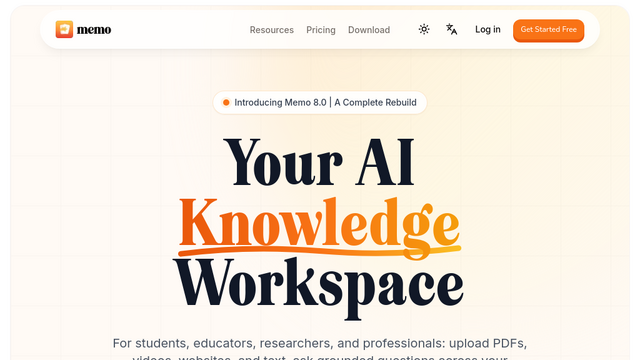
Memo is a high-performance, AI-native knowledge workspace designed for students, researchers, and professionals who handle information-heavy material. It converts unstructured source documents—such as textbooks, research PDFs, lecture slides, websites, and videos—into active recall study materials like flashcards, comprehensive summaries, Cornell notes, and multiple-choice tests. Built with a side-by-side workspace view, Memo enables deep, cited research and structured spaced-repetition study directly on your sources.
Use Cases
Automated Active Recall Generation
Upload massive textbook chapters, research papers, or lecture slides to instantly generate high-quality Q&A cards, cloze deletions (fill-in-the-blanks), or quizzes.
Side-by-Side Context-Aware Research
Review generated notes or flashcards adjacent to your original document, with direct, page-by-page citations showing exactly where the AI extracted the knowledge.
Multi-Format Information Synthesis
Feed YouTube videos, lecture recordings, web links, or text logs into the platform to synthesize structured notes, clear tables, and detailed chapter summaries.
Interactive Study & Memory Review
Use built-in Active Recall layouts (like Column View, Toggle List, or Typing Mode) paired with spaced repetition algorithm schedules to study materials without leaving the app.
Seamless Anki & Quizlet Exports
Generate flashcard files natively format-optimized for immediate, one-click export as .apkg for Anki or .csv for Quizlet ecosystems.
Features & Benefits
Source-Grounded Copilot
Features a specialized conversational assistant (‘Memo Cats’) that anchors its reasoning strictly to your uploaded documents, preventing external hallucinations.
Page-Specific Regeneration
Allows you to select explicit pages within a document and prompt the AI with targeted rules, such as ‘;create more definition-type flashcards.’
Multi-Format Note Generation
Supports instant rendering of study notes across multiple proven educational schemas, including Cornell Notes, structured matrices, and concise summaries.
Comprehensive Document-to-Speech
Includes a multimodal audio layer supporting 32+ languages that can narrate, break down diagrams, and explain complex charts out loud.
Automated Audio-Visual Sync
Features auto page-flipping and text synchronization that mimics a real-time karaoke or lyric layout when reviewing audio transcriptions.
Dual LLM Infrastructure Engine
Powers generation tasks by combining a fine-tuned OpenAI GPT framework with a custom-trained private model specialized in academic question extraction.
Massive Time Savings
Eliminates the hours spent copy-pasting and manually building flashcards slide-by-slide, saving up to 15–20 hours a week for conceptual workloads.
Strict Context Continuity
The page-by-page mapping and side-by-side view keep your reference context intact, making it exceptionally easy to clarify ambiguous concepts.
Ecosystem Compatibility
Maintains a first-class integration with established spaced-repetition software, completely honoring its heritage as a dedicated PDF-to-Anki gateway.
Cons
Granularity Controls Require Prompt Tuning
The default generation configurations can sometimes output text-heavy answers, requiring users to explicitly leverage the inline copilot for short, high-quality clozes.
Premium Consumption Gaps
Heavy multi-document processing or large media transcriptions require continuous utilization of paid tier limits to support the platform’s compute backend.