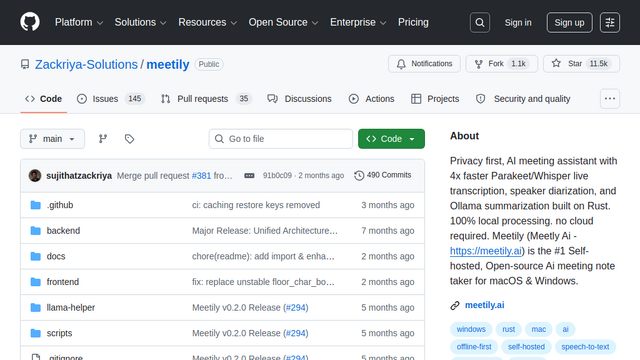
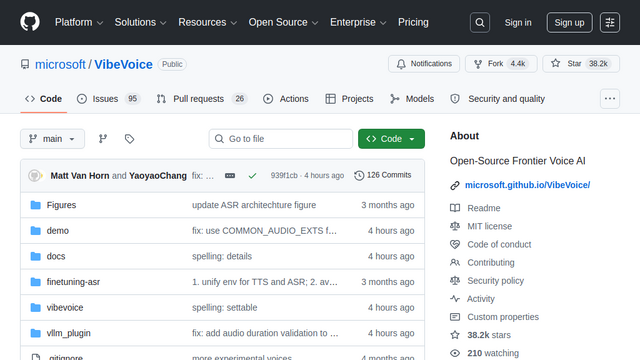
Meetily is a self-hosted, MIT-licensed AI meeting note-taker and transcription assistant built on a high-performance stack of Rust, Tauri, Next.js, and FastAPI. Engineered with a strict ‘local-first’ philosophy, Meetily handles live multi-platform meeting audio capture, speaker diarization, and transcription entirely on your local hardware using optimized Parakeet and Whisper.cpp engines. It completely eliminates cloud data leaks and expensive per-minute transcription subscriptions by pairing local audio capture with flexible LLM summarization powered by local Ollama instances or direct cloud APIs.
Use Cases
Sovereign Corporate Meeting Intelligence
Record and analyze internal executive briefings, financial retrospectives, or proprietary strategy sessions with 100% data sovereignty, ensuring sensitive corporate conversations never leave your network.
Cost-Controlled Client Transcripts
Process hundreds of hours of multi-party client discussions, project handoffs, and feedback sessions completely free of unmetered, escalating cloud SaaS subscription fees.
Offline Field & Remote Transcription
Deploy the desktop workspace in low-connectivity environments or restricted secure spaces to log, transcribe, and summarize live discussions entirely offline.
Multilingual Team Documentation
Automatically capture and structure mixed-language corporate workshops, supporting over 99 distinct languages and diverse accents natively out of the box.
Customized Post-Processing Workflows
Export pure timestamped transcript JSONs, Markdown summaries, or PDFs directly into external private knowledge bases, custom LLM agents, or corporate wikis.
Features & Benefits
On-Device Whisper & Parakeet Engines
Leverages highly optimized C/C++ audio frameworks to deliver up to 4x faster real-time transcription speeds directly on local CPU/GPU or Apple Silicon.
Modular LLM Orchestration
Provides absolute freedom over the reasoning layer, offering plug-and-play support for local endpoints (Ollama, LM Studio) or frontier APIs (Claude, Groq, OpenAI, OpenRouter).
Tauri & Next.js Desktop Framework
Combines a lightweight, fast Rust runtime with a sleek, responsive Next.js user interface available across macOS, Windows, and Linux.
Custom Summary Templates
Allows developers to inject personalized system prompts, project-specific vocabulary constraints, and explicit role definitions into the summary request builder.
Batch Audio/Video Importer
Enables rapid retrospective processing by accepting manual imports of existing local media files (MP4, MKV, WAV) for background re-transcription.
Unrestricted MIT License
Fully open source with zero attribution lockouts or commercial limitations—allowing you to fork, adapt, or build it directly into your own enterprise software suites.
Zero Data Capital Footprint
Protects intellectual property by executing the foundational transcription step completely on-device, offering a rigid wall against cloud interception.
High Token & Payload Efficiency
By compiling complex audio data into structured text local-first, it prevents context window blowouts when sending final summaries to external reasoning models.
Cons
Hardware Resource Allocation
Running real-time, heavy transcription models locally along with active meeting apps can occasionally push low-spec or aging employee laptops to their computing limits.
Manual Tool Management Overhead
Setting up custom summary templates, managing localized Ollama model weights, or updating homebrew/cask system dependencies requires basic technical literacy.