VoxCPM | Tokenizer-Free TTS for Multilingual Speech Generation
VoxCPM
Introduction
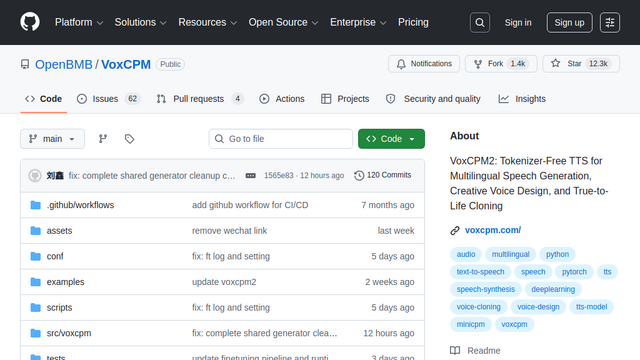
VoxCPM is an open-source, high-performance omni-modal model developed by OpenBMB and THUNLP(Tsinghua University). It is designed for seamless, real-time interaction across multiple modalities—specifically text, image, and high-fidelity audio. Unlike traditional ‘cascaded’ systems that use separate STT (Speech-to-Text) and TTS (Text-to-Speech) modules, VoxCPM employs an end-to-end architecture. This allows it to perceive and generate speech with emotional nuances and environmental context, enabling a fluid, ‘human-like’ conversational experience with significantly lower latency.
Use Cases
Next-Gen Real-Time Voice Assistants
Create conversational agents that can listen and speak simultaneously, understand interruptions, and respond with human-like emotional intelligence.
Zero-Shot Voice Cloning
Clone any voice with high fidelity using only a 3 to 10-second audio sample, maintaining the original speaker’s accent, pitch, and emotional cadence.
Multimodal Visual Narration
Combine vision and speech capabilities to let the AI ‘see’ an image or video and describe it in real-time with an expressive, context-aware voice.
Cross-Lingual Content Creation
Generate speech in over 30 languages while maintaining the same voice profile, enabling creators to localize content without losing brand identity.
Immersive Gaming & Roleplay
Power NPCs (Non-Player Characters) with voices that automatically adapt their tone and speed based on the narrative context or player interactions.
Features & Benefits
Tokenizer-Free Continuous Modeling
Directly models the continuous distribution of speech, preserving acoustic details that are often lost in traditional discrete tokenization methods.
Unified Omni-modal Architecture
A single model architecture that processes text, vision, and audio, reducing the latency and ‘telephone effect’ associated with cascaded STT-LLM-TTS systems.
Studio-Quality 48kHz Output
Integrated with AudioVAE V2 and ZipEnhancer to produce high-fidelity, noise-free audio that is ready for professional use.
Low-Latency Inference (RTF < 0.15)
Highly optimized for real-time applications; on consumer-grade GPUs like the RTX 4090, it can generate speech much faster than real-time.
Advanced Emotional Steering
Users can control the intensity of emotions (e.g., happiness, sadness, excitement) through natural language prompts or reference audio clips.
Open Source & Commercial Friendly
Released under the Apache 2.0 license, allowing developers to self-host and customize the model for private or commercial applications.
Exceptional Voice Similarity
Consistently ranks high in speaker similarity (SIM) and naturalness (MOS) benchmarks compared to other open-source and proprietary models.
High Efficiency
Designed to run on consumer hardware, making advanced omni-modal AI accessible to individual developers and small teams.
Cons
High VRAM Usage for Multi-modal Tasks
Running vision and audio processing concurrently can be memory-intensive, requiring high-end consumer or enterprise GPUs for optimal performance.
Complex Fine-Tuning
The continuous modeling approach, while superior in quality, requires more specialized knowledge to fine-tune compared to traditional text-based LLMs.