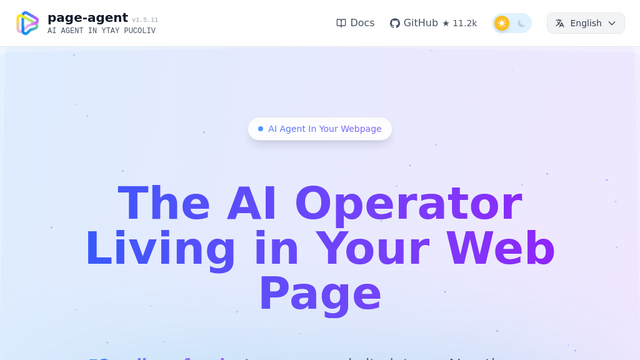
PageAgent is an open-source JavaScript library developed by Alibaba that acts as an autonomous GUI (Graphical User Interface) agent embedded directly within any web page. Unlike traditional browser automation tools that run externally, PageAgent lives inside your application via a simple script tag or npm package. It uses a ‘text-based DOM manipulation’ approach—reading the page structure as text rather than taking screenshots—allowing it to understand and operate complex web interfaces using natural language commands without the need for high-cost multimodal LLMs or special browser permissions.
Use Cases
Instant SaaS AI Copilot
Transform any existing SaaS product into an AI-powered application with a few lines of code, allowing users to control the UI through a natural language chat interface.
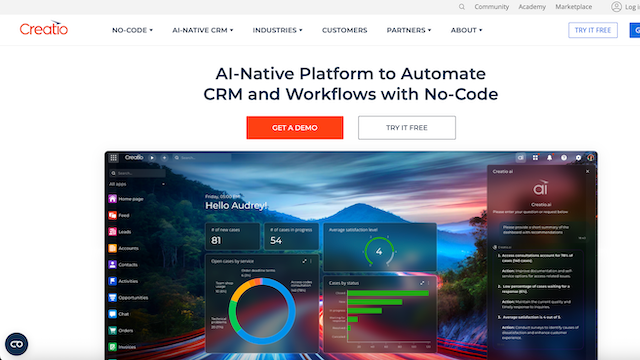
Smart Form Filling for ERP/CRM
Turn tedious 20-click workflows and 30-field forms (like those in SAP or Salesforce) into a single sentence: \”Create a new lead for John at Acme Corp.\”
Automated In-Page Customer Service
Empower support bots to move beyond ‘telling’ users what to do; they can now ‘do’ it for them, such as submitting a ticket or updating account settings directly.
Accessibility Enhancement
Provide an assistive layer for visually impaired or elderly users, enabling them to navigate complex menus and execute actions via voice commands or screen readers.
Natural Language QA Testing
Allow QA teams to write and maintain automated test scripts in plain English (e.g., \”Go to checkout and verify the discount is applied\”) without writing boilerplate code.
Features & Benefits
Pure Front-End Solution
Operates entirely within the browser’s JavaScript environment. No backend rewrite, headless browsers (like Playwright), or Python infrastructure are required.
‘Bring Your Own LLM’ (BYOLLM)
Compatible with any model following the OpenAI API format (GPT-4, Claude, Qwen, Mistral), giving you full control over costs and data privacy.
Smart DOM Analysis
Uses a ‘high-intensity dehydration’ technique to strip away unnecessary HTML noise, sending a clean, text-only representation of the page to the LLM for fast, low-token processing.
Human-in-the-Loop (HITL) Validation
Natively integrates a validation system where the agent proposes specific actions (clicking a button, filling a field) for the user to approve before execution.
Optional Chrome Extension & MCP Support
An optional extension enables the agent to perform multi-page tasks across tabs, while a Beta MCP (Model Context Protocol) server allows external control.
Extreme Implementation Speed
Enables developers to ship sophisticated AI agent features in hours by simply adding a script, rather than re-engineering the application’s core logic.
Significant Cost Savings
By processing text instead of images/screenshots, it reduces LLM token consumption by 10x-100x compared to multimodal vision-based agents.
Privacy & Security Control
The project is MIT-licensed and fully open-source; data transmission occurs only between the user’s browser and their chosen LLM provider.
Cons
In-Page Scope Limitations
Without the optional Chrome extension, the agent is restricted to the current page context and cannot navigate across different domains or browser tabs.
Complex UI Edge Cases
While highly robust, extremely non-standard or ‘div-heavy’ canvas-based UIs may still require custom hints or instructions to be fully understood by the agent.