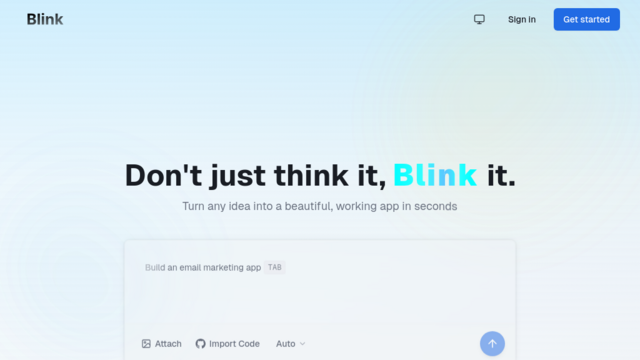
Blink is an AI-native app builder and cloud-based IDE designed to turn natural language prompts into fully functional, production-ready software. It acts as an ‘AI teammate’ for developers and entrepreneurs, allowing them to build, iterate, and deploy full-stack web applications, SaaS platforms, and internal tools through a conversational interface. By managing the underlying infrastructure, code generation, and deployment, Blink simplifies the transition from an initial idea to a live URL.
Use Cases
Rapid MVP Development
Quickly launch functional prototypes for startups to validate product-market fit without hiring a full engineering team.
Custom Internal Tools
Build specialized business applications such as CRM dashboards, inventory trackers, or employee portals tailored to specific workflows.
SaaS Prototyping
Generate and host sophisticated software-as-a-service applications with integrated backends and user authentication.
Iterative Code Refactoring
Use AI agents to update existing features, fix bugs, or change design layouts through simple chat-based instructions.
PWA Creation
Develop mobile-optimized web apps that can be ‘installed’ on user devices like native applications without going through traditional app stores.
Features & Benefits
Prompt-to-Production Engine
Converts descriptive text into structured codebases, covering frontend UI, backend logic, and database schemas automatically.
AI Agent Collaborator
Provides a real-time chat interface where users can command the AI to edit code, add new pages, or adjust styling instantly.
Cloud-Native Workspace
Features a built-in, browser-based editor and terminal that requires no local environment setup or dependency management.
One-Click Deployment
Includes integrated hosting with support for custom domains, SSL certification, and automated version control for easy updates.
Multi-File Awareness
The AI understands the context across the entire project structure, ensuring that changes in one file are consistently reflected in related components.
Drastic Time Savings
Reduces the development cycle from weeks to minutes by automating the most labor-intensive coding and setup tasks.
Accessible Development
Empowers non-technical founders and product managers to build complex software that previously required high-level engineering skills.
Integrated Ecosystem
Combines design, development, and hosting into a single unified platform, eliminating the need for multiple disparate tools.
Cons
Usage Credits
The AI’s reasoning and generation capabilities are metered by a credit system, which may become a limiting factor for high-frequency users on lower tiers.
Complex Edge Cases
While excellent for standard web architectures, highly niche or proprietary enterprise integrations may still require manual developer intervention.