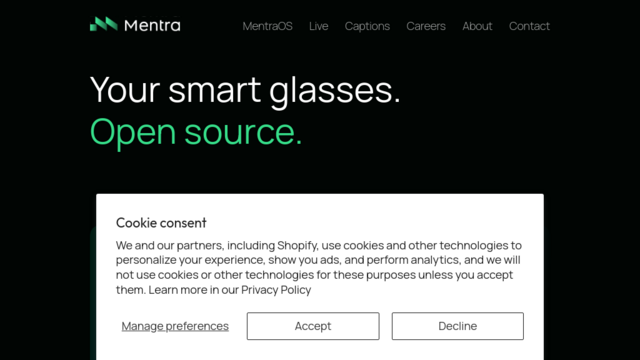
Mentra is a revolutionary wearable technology platform that breaks the ‘walled garden’ approach of traditional smart glasses. It is the world’s first open-source AI glasses ecosystem, powered by MentraOS. Unlike proprietary competitors, Mentra is built as a developer-first platform that allows anyone to build, deploy, and share custom AI applications through its integrated App Store, making it the most extensible and customizable smart eyewear on the market.
Use Cases
Custom AI Application Development
Developers can build and deploy niche AI tools tailored to specific professional or personal needs using the open-source SDK.
Enterprise Workflow Automation
Companies can create proprietary apps for warehouse management, checklists, or hands-free technical support specifically for their staff.
Specialized Accessibility Solutions
Community members can develop and share unique apps that assist with specific disabilities, moving beyond generic ‘one-size-fits-all’ features.
Educational & Research Prototyping
Universities and researchers can use the open OS to experiment with human-computer interaction and wearable AI without hardware restrictions.
Personalized Productivity Hubs
Users can curate their own experience by downloading specialized apps from the store for real-time translation, transcription, or coding assistance.
Features & Benefits
Open Source OS (MentraOS)
Provides complete transparency and control over the software, allowing developers to modify the core experience and ensure data privacy.
Integrated AI App Store
A dedicated marketplace where users can browse, install, and update community-driven applications to expand the glasses’ functionality.
Developer SDK & API Access
Offers robust tools for building multimodal apps that leverage the integrated camera, microphone, and speakers for context-aware AI.
Platform Agnostic Extensibility
Designed to be the only AI glasses that allow third-party developers to build and monetize their own software directly on the hardware.
Multimodal AI Integration
Seamlessly combines visual and auditory data processing, enabling apps to ‘see’ and ‘hear’ to provide real-time intelligent feedback.